Class 7 | SST
Chapter 8 | How the Land Becomes Sacred
Aligned with CBSE | NCERT | School & Olympiad Standards
Focus on What Matters Most
The67Sprint
The Elements as Divine
- The NCERT text opens with a defining idea: ether, air, fire, water, earth, planets, all creatures, directions, trees and rivers are seen as organs of the supreme Lord's body — the foundation for why land is sacred.
- Sacredness means finding something holy, divine, and worthy of deep respect — not limited to buildings like temples, mosques or churches, but extending to nature itself.
Tīrtha & Tīrthayātrā
- Tīrtha literally means a river "ford" or crossing; symbolically, a spiritual crossing from ordinary life to a higher state.
- Tīrthayātrā (pilgrimage) is a two-fold journey: an inner journey of self-discipline, and an outer journey across the land.
The Chār Dhām
- Four sacred sites at the corners of India unify its geography: Badrinath (North), Rameswaram (South), Jagannath Puri (East), Dwarka (West).
Badrinath — N
Puri — E
Rameswaram — S
Dwarka — W
Sacred Ecology
- Mountains are seen as symbolic gateways from earth to heaven (Mount Kailash, Tirumala).
- Rivers like the Ganga and Yamuna are worshipped as goddesses and lifelines since Vedic times.
- Environmental thinker David Suzuki notes: seeing a mountain as a deity rather than a resource teaches us to treat nature with respect and conserve it.
Shared Heritage
Sacred sites in India include indigenous traditions (Hindu, Buddhist, Jain, Sikh) and imported traditions (Islam, Christianity, Judaism), such as Dargah Sharif in Ajmer and Velankanni Church in Tamil Nadu.
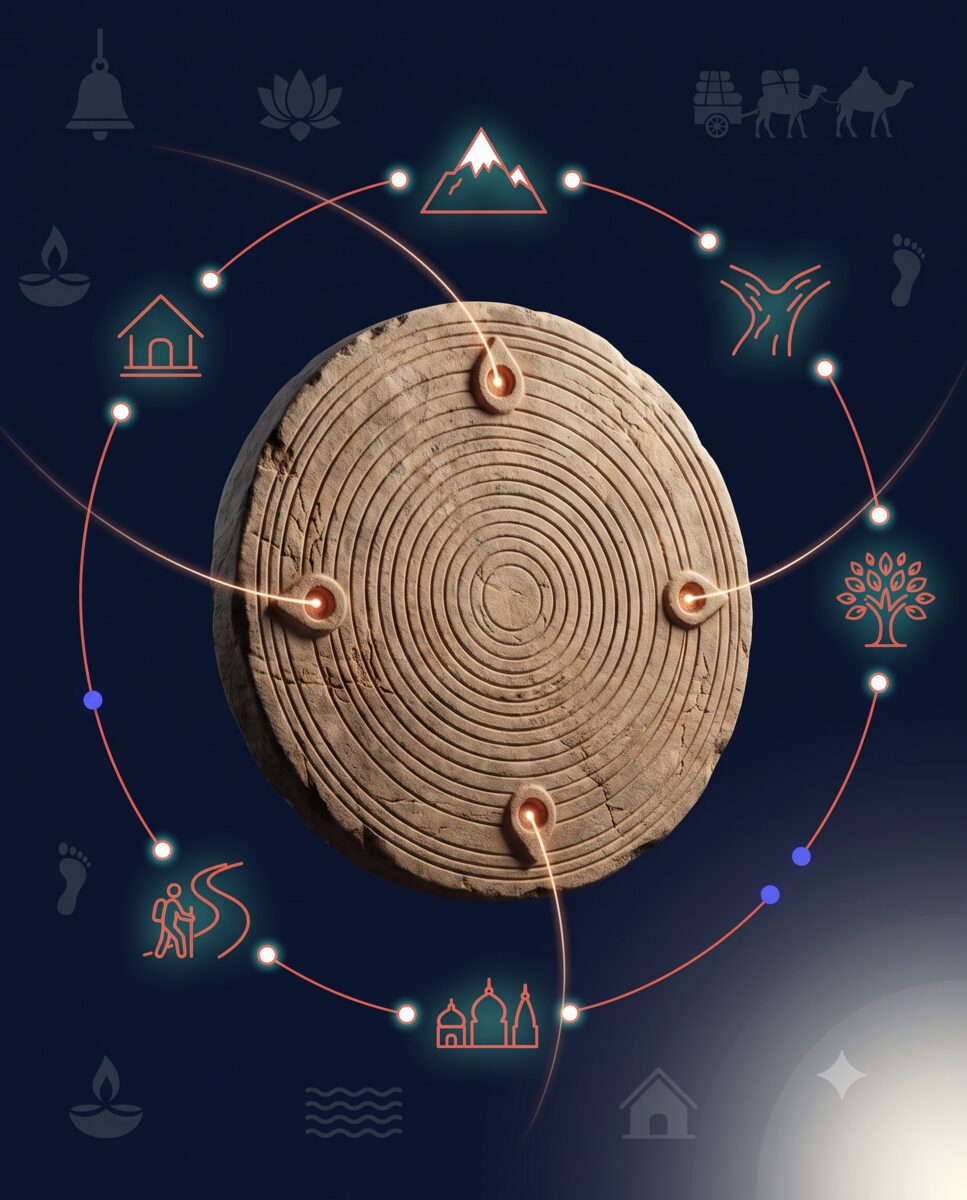
Quick Recall — Sprint Facts
Sacred Ecology
Rivers, mountains and forests worshipped as divine; Earth seen as Bhūdevī (Mother Earth).
Sacred Groves
Community-protected forests where hunting and tree-felling are taboo.
Pilgrimage Routes
Overlapped with ancient trade routes: Uttarāpatha (North), Dakṣiṇāpatha (South).
Cultural Integration
Travel across diverse languages, foods and customs wove India into one identity.
Key Terms to Know
🔑 Sacred
Considered holy, divine, or highly respected for spiritual significance.
🔑 Pilgrimage
A journey to a holy place for religious or spiritual growth.
🔑 Tīrtha
Literally a river "crossing"; symbolically, a spiritual crossing point.
🔑 Shrine
A holy place or structure dedicated to a deity, saint, or sacred relic.
🏆 Olympiad & Challenger Edge
Cultural Cartography
The 12 Jyotirlingas and 51 Shakti Pīṭhas form an ancient network of shrines mapping the subcontinent, symbolising the land as the body of the Divine Mother.
Regional Grove Names
Community-protected forests carry regional names: Kāvu (Kerala), Devarāī (Maharashtra), Sarnā (Jharkhand), Oraṇ (Rajasthan).
Global Sacred Geography
The Māori of New Zealand won legal personhood for their mountain, Taranaki Maunga — a modern parallel to seeing nature as living and sacred.
Tradition vs. Degradation
Ancient reverence for rivers and mountains contrasts with modern industrial pollution and mining — how do we turn reverence into active conservation policy?
Define Tīrtha Fully
Don't just write "a holy place" — include both the literal meaning (river crossing) and the symbolic meaning (spiritual transition).
Sacredness Beyond Buildings
Always mention that rivers, mountains, and sacred groves are worshipped as divine — not just temples or churches.
Pilgrimage's Economic Role
Highlight that pilgrimages boosted local trade, transport, and markets — not just religious duty.
Link Past to Present
Top-scoring answers connect ancient river worship to today's duty to protect polluted rivers like the Yamuna — this shows higher-order thinking.
Tourism & Local Business
Events like the Kumbh Mela support street vendors, guides, and hotel owners through millions of visiting pilgrims.
Everyday Environmentalism
Treating your local park or lake with the same respect as a sacred site — not littering — is sacred ecology in practice.
Supporting Local Livelihoods
Buying a souvenir or snack at a shrine or mela directly supports the centuries-old pilgrimage economy.
Map Labelling Errors
Mark the Chār Dhām at exact cardinal points on an outline map — vague placements lose marks.
Incomplete Definitions
Missing either half of Tīrtha's two-fold meaning (literal + symbolic) costs marks.
Poor Answer Formatting
Long answers written as one big paragraph — without headings, bullets or underlined keywords — lose marks.
Only Religious, Not Economic
Treating pilgrimage as purely a religious duty misses the socio-economic angle examiners look for — always mention trade and cultural integration too.
Logic Chain — How Land Becomes Sacred in India
Step 1
Reverence for life-giving Nature connects to natural sites being seen as divine.
Step 2
Divine natural sites connect to becoming Tīrthas — sacred crossing points.
Step 3
Tīrthas connect to Tīrthayātrās — pilgrims undertaking journeys across the land.
Step 4
Pilgrimage routes connect to cultural integration and economic growth across the subcontinent.
🦉
Mentor Byte
A land remembered as sacred is a land that gets protected — long before laws existed, reverence was the policy. Every river worshipped as a goddess, every grove left uncut, was ecology enforced by belief instead of by government. When you see a temple by a river today, you are looking at one of humanity's oldest conservation systems, still quietly at work.
Parent Tip
Ask your child to name one "sacred" spot in your own neighbourhood — a park, tree, or lake — and discuss why treating it with care matters, just like the sacred sites in this chapter.