Class 6 | English
Chapter 14 | The Kites
Aligned with CBSE | NCERT | School & Olympiad Standards
Focus on What Matters Most
The67Sprint
📚 Core Text & Author
- "The Kites" is a poem by Daphne Lister
- Chapter 14, Unit 5 (Culture and Tradition), NCERT Class 6 English, Poorvi
Poem 🪁
📐 Structure & Rhyme — ABCB
- 5 stanzas of four lines each (quatrains): 20 lines in all
- ABCB: the second and fourth lines of each stanza rhyme
- fly–sky • air–there • wings–sings • down–town • stare–air
ABCB
🌬️ Stanza 1 — Observing Flight
- The poet watches colourful kites soaring in a strong, windy sky
- Their graceful motion is compared to coloured birds
✨ Stanza 2 — The Child's Wish
- The speaker wishes to become small and as light as air
- The wish is to climb onto a kite and ride high into the sky, not to turn into a kite
🎶 Stanza 3 — Floating & Nature's Sounds
- The speaker drifts gently on the kite's "paper wings"
- The fast-moving wind makes a musical sound: "wild wind sings"
🏘️ Stanza 4 — Aerial Perspective
- Riding on the kite gives a thrilling view from above
- The speaker looks down at the town's parks and rooftops
👀 Stanza 5 — Admiration from Below
- People on the ground look up in wonder
- They admire the speaker and wish they could soar so high too
🪁 Parts of a Kite
- Nose — the top tip or corner
- Spine — the vertical central stick, the backbone
- Cover — the outer paper or fabric body
- Kite line — the string used to fly and steer
- Reel (lattai) — the spool around which the line is wound
- Tail — ribbon or fabric strips at the bottom for balance
✍️ Cinquain — Creative Writing
- A five-line poem describing one topic
- Line 1: 1 word (noun), e.g. Kite
- Line 2: 2 words (adjectives), e.g. pretty, colourful
- Line 3: 3 words (action words), e.g. flying, floating, soaring
- Line 4: 2 words (adverbs), e.g. quickly, happily
- Line 5: 1 word (synonym), e.g. paper-bird
1 – 2 – 3 – 2 – 1
🎭 Devices in the Poem
- Simile — "like coloured birds", "as light as air"
- Metaphor — "paper wings"
- Personification — "wild wind sings"
- Alliteration — wind-whipped, wild wind sings, stand and stare
- Repetition — "high, high" for emphasis
Central Idea
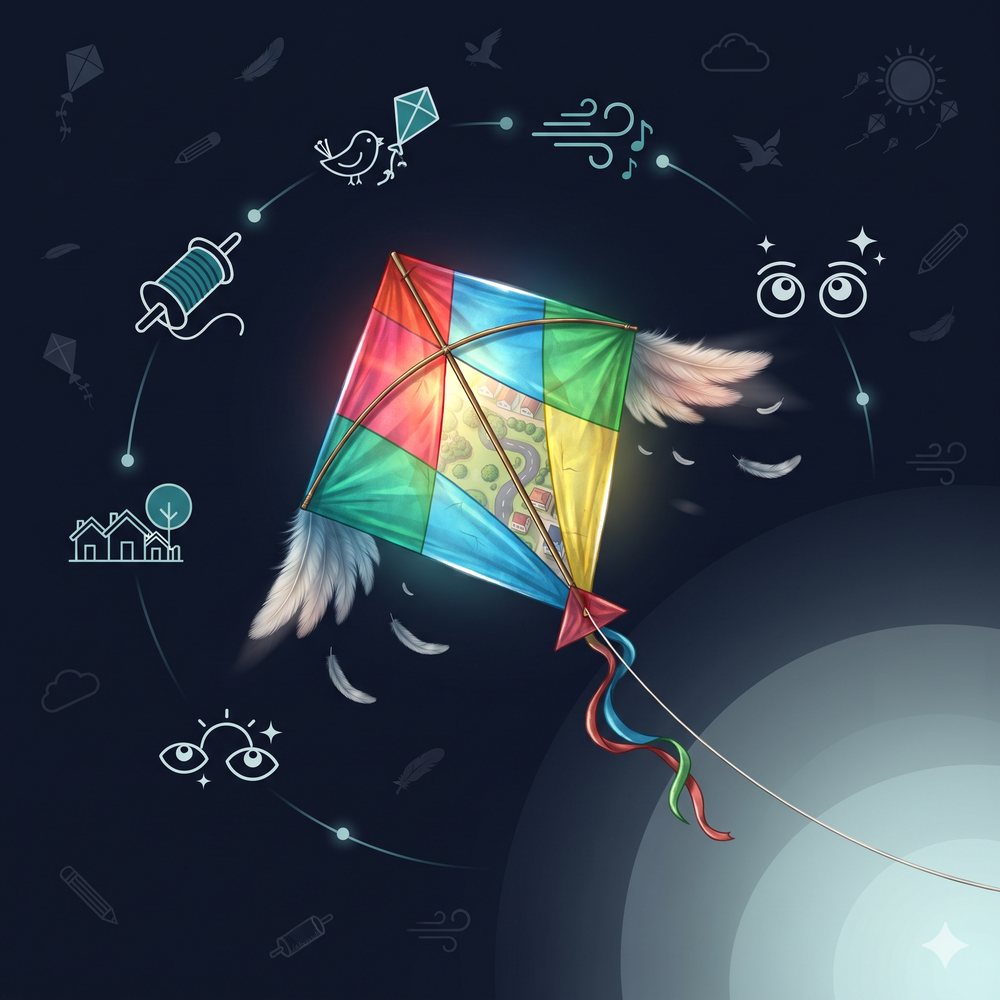
Freedom and imagination. A child's daydream of riding a kite shows adventure, a new perspective and the wonder of flight.
Quick Recall — Sprint Facts
Poet
Daphne Lister
Textbook & Unit
NCERT Class 6 Poorvi, Unit 5 (Culture and Tradition), Chapter 14
Structure
5 quatrains, 20 lines
Rhyme Scheme
ABCB in all five stanzas
Speaker's Wish
To become small and as light as air, then climb onto a kite and ride it
Aerial View
Looking down over the town's park and rooftops
Spectators
Stand, stare in wonder and wish they were the speaker
Figures of Speech
Simile, metaphor, personification, alliteration, repetition
Namadeva (13th Century)
Marathi saint-poet; gudi from kaagad (paper), in his gathas
Makar Sankranti / Uttarayan
January: Gujarat, Rajasthan, Telangana
Punjab
Basant Panchami and Baisakhi
Karnataka
Annual events organised by the Tourism Department
Independence Day
15 August: kites flown across India
Kite Types
Diamond-shaped, box kite, parafoil, delta, rokkaku
🔑 Key Terms
Wind-whipped sky
A sky where strong, fast winds blow vigorously
Sail up
To move smoothly and effortlessly upwards, like a boat gliding on water
Drift
To float slowly and gently through the air without force
Paper wings
The paper structure of the kite that makes flight possible; a metaphor for bird wings
Wild wind sings
The musical, whistling sound of rushing wind currents
Stare
To look intently and steadily for a long time, with focus or amazement
Simile
A comparison of two different things using "like" or "as"
Metaphor
A direct, implied comparison without "like" or "as"
Alliteration
Repetition of the same initial consonant sound in nearby words
Personification
Giving non-living things or nature human qualities or actions
Imagery
Descriptive language that creates vivid sensory or mental pictures
Cinquain
A five-line poem describing a subject with a fixed word-count pattern per line
🏆 Olympiad & Challenger Edge
Visual Imagery
"Coloured birds", "wind-whipped sky" and the park and rooftops of the town paint pictures for the eye.
Auditory Imagery
"Wild wind sings" creates a melodic, musical atmosphere of nature.
Kinesthetic Imagery
Drifting on paper wings, sailing up and climbing on a kite convey the feeling of motion.
The Kite as Symbol
The kite stands for human imagination, freedom and ambition, breaking free of everyday limits.
The Wind as Symbol
The wind is the unseen, supportive force of nature that helps dreams rise.
The High View as Symbol
Seeing from above stands for a broader, more elevated outlook on life.
Shift in Perspective
Stanzas 1–2 look up from the ground; stanzas 3–4 look down from the air; stanza 5 returns to the ground, with people looking up at the speaker.
Wind & Flight Words
Drift: smooth, effortless floating. Glide: graceful horizontal movement. Soar: rapid, sustained upward climb. Swoop or dive: sudden downward plunge.
❌ Child Wants to Become a Kite?
Wrong. The child wants to be small and light as air to climb onto and ride a kite. Mark such a statement False.
❌ A Rainy Day?
Wrong. "Wind-whipped" means strong, blowing wind. It was a bright, windy day.
❌ "Paper Wings" Is a Simile?
Wrong. It is a metaphor. "Like coloured birds" and "as light as air" are similes (they use like or as).
❌ Alliteration by Letters?
Alliteration depends on sounds, not letters: "wild wind sings" repeats /w/; "kites" and "coloured" share /k/.
❌ All Four Lines Rhyme?
Wrong. The scheme is ABCB: lines 2 and 4 rhyme (fly–sky), but lines 1 and 3 do not (air and birds).
✍️ Match Stanza to Theme
1 observing flight; 2 the wish; 3 floating and wind's song; 4 the view from above; 5 admiration from below.
✍️ Quote and Name the Sound
Don't only name a device. Quote the line and name the repeating sound, e.g. /w/ in wild wind sings.
✍️ Spectators' Reaction
People stare in wonder, amazement and envy because a child riding a kite is an extraordinary, magical sight.
🎉 Cultural Traditions
Kite festivals like Makar Sankranti, Basant Panchami, Baisakhi and Independence Day bring outdoor play, teamwork and family bonding.
🌬️ Wind and Flight in Daily Life
A kite shows air resistance, wind speed, lift and the balance given by the tail.
🗺️ Perspective and Observation
Imagining the view of parks and rooftops from above builds a sense of space, like a map of your town.
📝 Creative Writing Practice
Writing a cinquain applies noun, adjective, participle and adverb rules in a fun, short form.
🔧 Hands-On Craft
Building a kite with sticks, paper and string teaches measuring, right angles and balance.
🔠 Spellings
Write Daphne Lister (not "Lester"), Cinquain (not "Cinquan" or "Cinquin") and Reel (a spool), not "Real".
🏷️ Device Labels
"As light as air" and "like coloured birds" are similes; "wild wind sings" is personification; "paper wings" is a metaphor.
📖 Quote the Context
When asked why people stand and stare, mention wonder, amazement and envy, not just "looking at the sky".
🧮 Cinquain Word Counts
Follow 1-2-3-2-1: one noun, two adjectives, three action words, two adverbs, one synonym. Extra words lose marks.
🏠 Where Is the Speaker?
The speaker imagines looking down at the town's rooftops from a kite. Not standing on a rooftop.
📜 Namadeva Facts
13th-century Marathi saint-poet; in his gathas a kite is gudi and paper is kaagad.
🎉 Festival–State Pairs
Makar Sankranti/Uttarayan: Gujarat, Rajasthan, Telangana. Basant Panchami and Baisakhi: Punjab. Karnataka: Tourism Department events.
🪁 Kind of Kites
Diamond-shaped, box kite, parafoil, delta and rokkaku.
🪁 Kite Parts
Know nose, spine, cover, kite line, reel and tail, and the job of each.
Logic Chain — How a Wish Becomes a Flight
Step 1 — Watching
Seeing colourful kites in the wind-whipped sky leads the child to wish to be small and as light as air
Step 2 — Climbing
That wish leads the child to climb onto a kite and sail up into the air
Step 3 — Drifting
Riding on paper wings leads to hearing the wind sing and seeing the park and rooftops from above
Step 4 — Wonder
The sight of a child flying high leads people below to stand, stare and wish they could fly too
🦉
Mentor Byte
"Treat 'The Kites' as a journey of the imagination. Recite it aloud to feel the ABCB rhythm and the alliteration. Link each device to its effect: the simile 'like coloured birds' shows the flight of the kites, and personification ('wild wind sings') adds sound. Separate the poem's literal details (paper kites flown at Makar Sankranti or Uttarayan) from its figurative language. In writing, follow the cinquain's word-count and parts-of-speech rules exactly."
For Parents
Read the poem aloud together and clap at each rhyming pair. Then write a cinquain about something at home, following the 1-2-3-2-1 pattern. If you fly a kite, do it in an open area away from roads and power lines.