Class 6 | English
Chapter 2 | The Raven and the Fox
Aligned with CBSE | NCERT | School & Olympiad Standards
Focus on What Matters Most
The67Sprint
📚 Textual Context
- Unit 1 (Fables and Folk Tales), Chapter 2 of NCERT Class 6 English, Poorvi
- A classic fable in poetic form, adapted from the French poet Jean de La Fontaine
- Two characters: Mr. Raven (the bird) and Reynard the Fox
Fable 🦊
4 Stanzas
🌳 Stanza 1 — Setting & Conflict
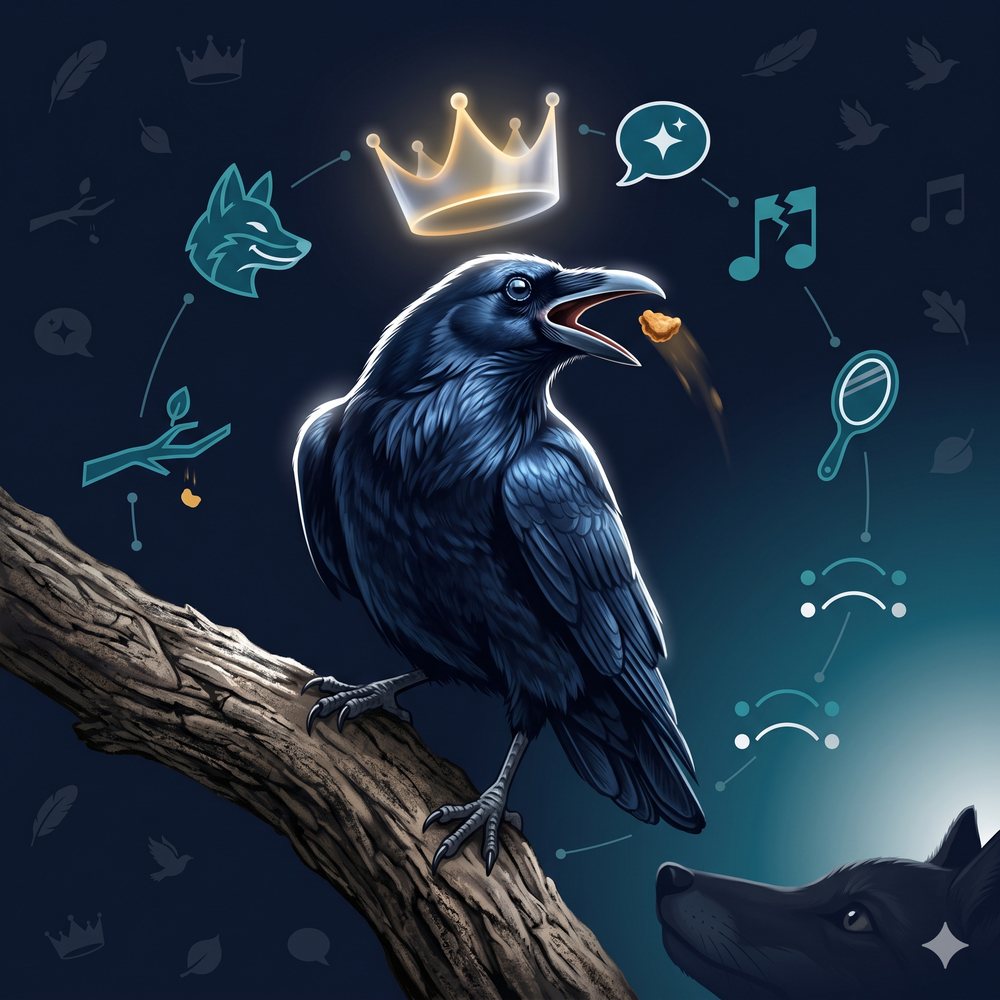
- Mr. Raven is perched high on a limb (tree branch)
- He holds a delicious morsel (a piece of food) in his big beak
- Reynard the Fox spots him from below
- The Fox seeks to obtain the food for his supper
🗣️ Stanza 2 — The Strategy of Flattery
- Reynard uses sweet, admiring tones rather than force
- He calls the Raven "Sir Raven" and praises his "handsome" looks and "shiny, beautiful feathers"
- He claims that if the Raven sang, the birds of the woods would crown him "King"
😮 Stanza 3 — The Fall into Pride
- Mr. Raven succumbs to foolish pride and fails to see the trick
- He forgets that his natural voice is only a harsh croak
- He opens his beak wide to show off his singing
- The morsel drops immediately
😂 Stanza 4 — The Lesson Delivered
- Reynard catches the falling food and laughs "Ha-ha!"
- He delivers the central moral: ignore deceptive praise that makes you "glow"
- Excessive pride is unwise
🎯 Why Flattery Worked
- The Raven sat high on a limb where the Fox could not reach or climb
- Physical force was impossible
- Reynard turned to flattery, which fed the Raven's vanity
- The Raven opened his beak by choice and dropped the food himself
⚖️ Character Contrast
- Reynard — sly and clever; calculating with words
- Mr. Raven — vain, proud and foolish; trusts praise without thinking
- Textbook analogy: Fox : clever :: Raven : foolish
Fox = clever
Raven = foolish
🎭 The Irony of the Moral
- Reynard himself used "sweet words" to trick the Raven
- After eating the food, he advises the Raven to ignore the very trick he just played
- This shows Reynard as sly and cynical, mocking the Raven's lack of critical thinking
Central Moral
"The flatterer lives at the expense of those who listen to him." Unchecked vanity blinds judgment — always ask the true motive behind sudden praise.
Quick Recall — Sprint Facts
Poet
Jean de La Fontaine
Textbook & Unit
NCERT Class 6 Poorvi, Unit 1: Fables and Folk Tales
Main Characters
Mr. Raven (bird) and Reynard (fox)
Raven's Location
Perched upon a limb of a tree in the woods
Raven's Possession
A morsel held in his great big beak
Fox's Weapon
Flattery — "Sir", praised feathers, the promise of being named "King"
Raven's Real Sound
A croak (a harsh sound)
Fox's Reaction
Laughs "Ha-ha!" and catches the falling food
Poem Structure
4 stanzas, 16 lines total, 4 lines per stanza
Rhyme Scheme
AABB across all stanzas
Rhymes: Stanzas 1 & 2
limb–him, beak–seek; word–bird, sing–King
Rhymes: Stanzas 3 & 4
joke–croak, pride–eyed; know–glow, unwise–surprise
Textbook Analogy
Fox : clever :: Raven : foolish
Central Moral
The flatterer lives at the expense of those who listen to him
🔑 Key Terms
Perched
Sat on a high or narrow branch or object
Morsel
A small piece of food
Limb
A main branch of a tree
Woods
A small forest area
Seek
To search for or try to obtain something
Eyed
Looked closely or with keen interest at something
Croak
A low, harsh sound made by ravens or frogs
Foolish Pride
Excessive self-esteem or feeling superior to others; unwise ego that clouds thinking
Flattery
Exaggerated or insincere praise given to manipulate someone
Glow
Feeling deeply pleased, proud or satisfied because of compliments
Unwise
Lacking wisdom; foolish or imprudent
Fable
A brief story, usually with animal characters, that ends with a clear moral lesson
🏆 Olympiad & Challenger Edge
Rhyme Scheme — AABB
Couplet format: the first two lines rhyme and the last two lines rhyme in every stanza (limb–him / beak–seek, word–bird / sing–King, joke–croak / pride–eyed, know–glow / unwise–surprise).
Alliteration
Repeated initial consonant sounds in close succession: /b/ in "great big beak", /s/ in "Such feathers! If you would only sing", /w/ in "woods would". Always name the sound that repeats.
Personification
Human traits — speech, cunning, vanity, pride and trickery — are given to animals: the Raven and the Fox.
Hyperbole
Dramatic exaggeration used by the Fox to manipulate the Raven: "The birds of these woods would call you King."
Onomatopoeia
Words that imitate natural animal or expression sounds: "croak", "caw" and "Ha-ha!"
Metaphor
Implicitly calling the Raven a "King" to flatter his ego.
Imagery
Vivid visual pictures: a raven perched high on a branch holding food in his beak, a fox gazing up from below, food falling down.
Analogy
Fox : clever :: Raven : foolish — a comparison of character roles drawn from the textbook activities.
❌ Fox Admired the Raven's Voice?
Wrong. Reynard used fake praise as a calculating trick to make the Raven open his beak.
❌ Raven Sang a Sweet Melody?
Wrong. He could only produce a harsh croak, and he forgot he could not sing while holding food.
❌ The Raven Delivers the Moral?
Wrong. Reynard ironically delivers the moral to the Raven after taking the food.
❌ Raven Smart, Fox Foolish?
Reversed. Use the textbook analogy: Fox : clever :: Raven : foolish. Never write Fox : proud :: Raven : clever.
✍️ Name the Sound in Alliteration
Quoting "great big beak" is not enough. Add: the repetition of the initial /b/ sound in "big" and "beak".
❌ Fox Won by Force?
Wrong. The Raven sat high on a limb the Fox could not climb. Reynard won through psychological manipulation: flattery that exploited the Raven's vanity.
❌ Moral Is Only About Pride?
Incomplete. The poem shows both sides of deceit: the danger of excessive pride and the manipulative nature of fake flattery.
✍️ Prove Your Figure of Speech
Name the device, quote the line and justify it. Hyperbole: "The birds of these woods would call you King" exaggerates to inflate the Raven's ego.
✍️ Rhyme Scheme Answers
State AABB and give the exact pairs, e.g. Stanza 3: joke–croak and pride–eyed.
🛡️ Cyber Safety & Phishing
Scammers send fake praise ("You are selected as our lucky winner!") to trick users into clicking links or sharing passwords — just as Reynard used "King" to take the food.
🤝 Peer Group Dynamics
Notice when a classmate over-praises you ("You're the smartest, please do my assignment!") to gain an unfair advantage.
📱 Social Media Validation
Chasing superficial "likes" or flattery can make you open to emotional manipulation and distract you from your true abilities.
🏅 Sports & Game Mind Games
Rivals may over-praise your earlier moves to break your focus at a crucial moment. Stay on the present play.
🔠 Spelling the Names
Write Reynard, not "Renard", "Raynard" or "Reynold". Write morsel, not "morsle" or "parcel".
🔤 Word Forms
Use the form the line needs: past tense perched (not "perch") and base verb seek (not "seeks"), as per context.
💬 Quote Accuracy
Copy it exactly: "The birds of these woods would call you King". Never write "all the animals would call you king".
📖 Glossary: Limb
In this poem a limb is a branch of a tree, not a human arm or leg.
🌲 Glossary: Woods
Woods means a small forest, not pieces of timber or construction wood.
🔁 Who Held the Food?
The Raven held the morsel in his beak; the Fox only eyed it from below. Do not swap the roles.
🎭 Explaining the Irony
Don't just write "the Fox is clever". Explain that Reynard, a flatterer himself, advises the Raven to ignore sweet words after using them to win the food.
Logic Chain — How Flattery Wins the Morsel
Step 1 — Desire
Mr. Raven perches on a limb with a morsel, which leads the hungry Fox to notice the food from below and want it
Step 2 — Flattery
Unable to climb, Reynard praises the Raven's feathers and promises him the title "King", which leads to the Raven's ego swelling
Step 3 — Foolish Pride
Foolish pride makes the Raven forget that his voice is a croak, which leads him to open his beak wide to sing
Step 4 — The Lesson
The morsel drops into the Fox's jaws, which leads Reynard to laugh "Ha-ha!" and teach that pride is unwise
🦉
Mentor Byte
"Class 6 students should remember that in fables, every character action drives a clear moral consequence. When analysing 'The Raven and the Fox', focus on the contrast between Reynard's calculated verbal cunning and Mr. Raven's uncritical vanity. In extract-based questions, don't just name a figure of speech — quote the line and name the sound, like /b/ in 'great big beak', or the exaggeration in 'call you King'. Remember that the poem follows AABB in every stanza, and that its moral covers both sides of deceit: the danger of excessive pride and the manipulative nature of fake flattery. Always reflect before trusting sudden praise!"
For Parents
Ask your child to read the four stanzas aloud and clap at each rhyming pair, then to spot a "Reynard moment" from daily life — such as a pop-up saying "You are our lucky winner!" — and explain why it is flattery. Linking the poem to real situations makes the moral stick.