Class 7 | SST
Chapter 6 | The State, the Government, and You
Aligned with CBSE | NCERT | School & Olympiad Standards
Focus on What Matters Most
The67Sprint
🏛️ The State vs. The Government
- The State is a permanent political organization with authority over a defined territory and population
- The Government is the temporary administrative system that makes and enforces laws on the State's behalf
- Analogy: the State is your whole school — building, students, rules. The Government is the principal and teachers, who change over time
- Don't confuse the Indian State (the nation) with subnational "states" like Karnataka or Maharashtra
🧩 Four Elements of a State
- People: a permanent population, not just visitors
- Land: a clearly defined territory with borders
- Government: the administrative system running the territory
- Sovereignty: supreme, independent power free from outside control — without it, a territory is just a colony
P-L-G-S 🔑
⚖️ Democracy vs. Republic
- Democracy: rule by the people, who choose leaders through free and fair elections
- Republic: the head of state is elected, not hereditary, and government power is limited by a Constitution
- India is both a Democracy and a Republic
- Not every democracy is a republic — the UK is a democracy but has a monarch as head of state
🏢 Three Organs & Two Executives
- Legislature makes laws, Executive implements laws, Judiciary interprets laws and protects rights
- Political Executive: elected leaders (PM, CMs) serving temporary terms
- Permanent Executive: bureaucracy/civil servants (IAS, IPS) who run daily administration permanently
- Three Tiers: Union (defense, currency), State (police, health), Local (streetlights, roads, water)
Memory Cheat Code
P-L-G-S = People, Land, Government, Sovereignty — the four elements a State must have. Missing Sovereignty costs full marks!
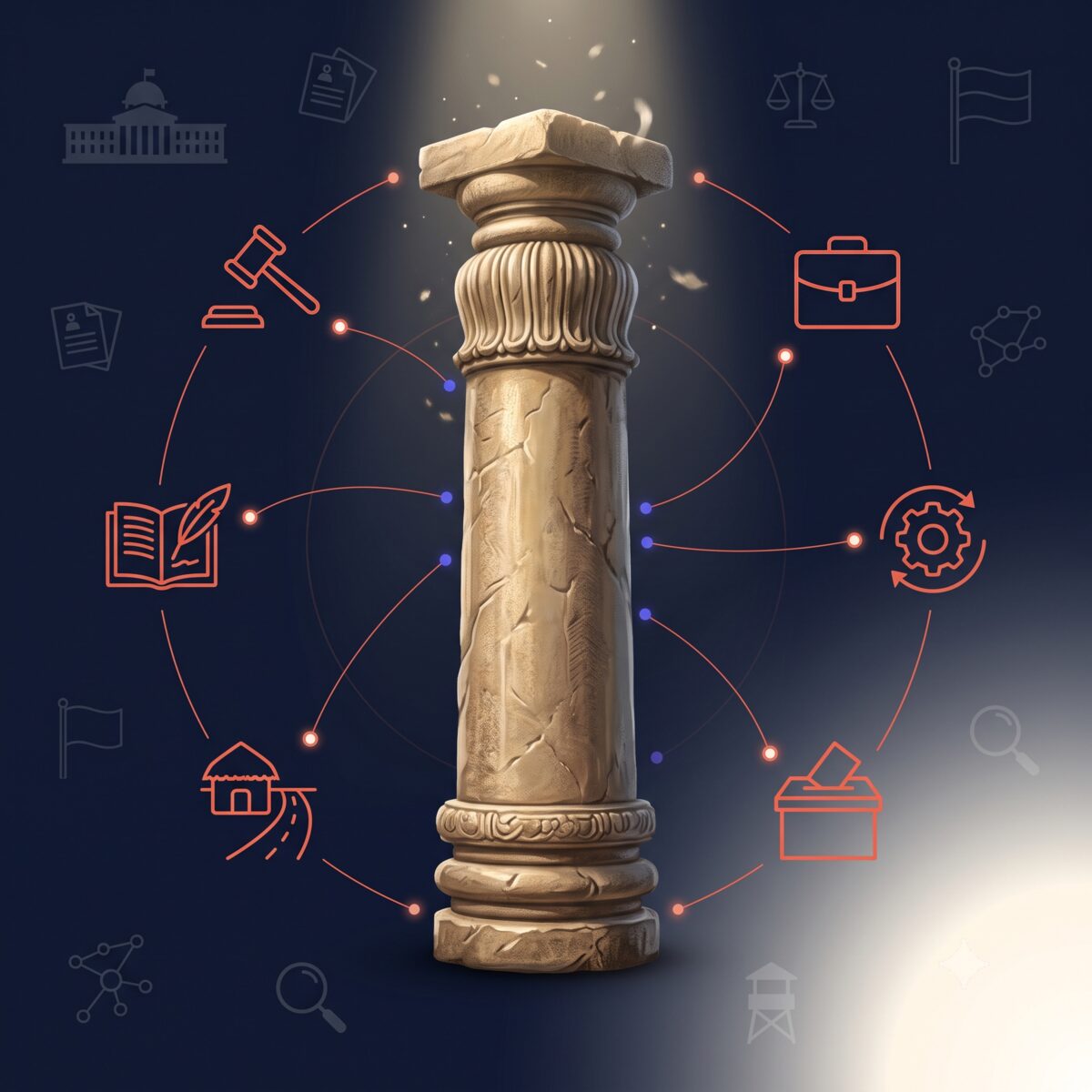
Quick Recall — Sprint Facts
Socrates Quote
"The greatest punishment for being unwilling to rule is being ruled by someone worse than oneself"
George Washington, 1782
Refused to become king, cementing the ideal of a constitutional republic
73rd & 74th Amendments
Created the "third tier" — Panchayats (rural) and Municipalities (urban)
C.B. Muthamma
First woman in the Indian Foreign Service (1949); won her case against a discriminatory marriage rule
Dongria Kondh Tribe
Republic protected their Niyamgiri hills from corporate mining despite majority economic interest
Triple Role of Govt
Protector, Provider, Regulator
🔑 Key Terms
State
The permanent political entity encompassing territory, population, government and sovereignty
Sovereignty
The absolute, supreme power of a state to make its own decisions without outside interference
Bureaucracy
The network of non-elected, permanent civil servants who run day-to-day administration
Decentralisation
Distributing power away from a central authority to local levels — villages and cities
Dominance of the Majority
When a democratic majority ignores or harms the rights of minority groups
Judicial Review
The Judiciary's power to strike down laws that violate the Constitution
Olympiad & Challenger Edge
Kautilya's Matsya Nyaya
Ancient Indian statecraft warns that without a legitimate state following Raja Dharma, society falls into "the law of the fish" — anarchy where the strong devour the weak.
Judicial Review as the Ultimate Shield
Even if 99% of a country votes to oppress the 1%, an independent judiciary can strike the law down as unconstitutional — the true test of a Republic.
Constitutional Monarchy vs. Republic
Why does the UK have no single written constitution like India or the USA? Explore how a monarch can be head of state with no real political power.
Limits of Judicial Power
Can the Judiciary overstep its boundaries? Explore the balance that stops judges from acting like lawmakers instead of interpreters of law.
❌ State = Government?
No. The State is permanent (like the school building); the Government is temporary (like the principal and teachers who change).
❌ Republic just means voting?
Wrong. A Republic strictly means the head of state is elected, not hereditary — voting alone only makes a country a democracy.
❌ IAS officers are elected?
No. Political Executive = elected and temporary (Ministers). Permanent Executive = selected via exams, career civil servants (IAS, IPS).
📌 Name the case study
When explaining Republic or RTI, always cite a real example — C.B. Muthamma, Dongria Kondh, or Bagepalli — not just the definition.
💡 The Class Monitor
Just as the school principal can't solve every pencil dispute, the national government can't fix a broken streetlight — that's why Local Government exists.
📋 The Bagepalli Scoreboard
Citizens used the RTI Act to see the official road-building budget and forced the government to rebuild it properly.
📱 Digital Watchdogs
Citizens tag handles like @RailwaySeva on social media to report problems and get instant executive action.
🏫 The RTE Act in Action
Legislature passes the Right to Education Act; the bureaucracy runs school meal schemes; courts step in if a child is denied admission — all three organs working together.
🚨 Missing Sovereignty
Students list People, Land and Government but forget Sovereignty — without it, it's a colony, not a State.
🚨 Incomplete tier diagrams
Forgetting to list Local Government alongside Union and State when mapping the tiers of government costs marks.
🚨 "Parliament can do anything"
Never write that the Legislature has unlimited power — lawmaking is always bound by the Constitution and subject to Judicial Review.
🚨 Wrong-chapter statecraft
Alexander the Great and the Chhatrups belong to the Rise of Empires chapter — don't mix them into State and Government answers.
🔗 Logic Chain — How a Law Reaches You
Step 1 — Legislature Debates
Parliament debates and passes a rule, connecting to the Political Executive setting policy direction
Step 2 — Political Executive Sets Goal
Elected ministers set the overarching policy goal, connecting to the bureaucracy putting it into action
Step 3 — Bureaucracy Implements
Permanent civil servants run the scheme on the ground, connecting to citizens experiencing its effects
Step 4 — Judiciary Watches
Courts step in as the watchdog if the law violates fundamental rights, connecting back to protecting every citizen
🦉
Mentor Byte
"For 7th graders, abstract ideas like 'the State' versus 'the Government' can feel dry on the page. Ground this chapter in what's right outside their door. Ask them: who fixed the pothole outside their building? Who manages the police station nearby? Who prints the money in their pocket? Once they map the textbook onto the street outside their house, civics stops being a subject and starts being a superpower they'll use for the rest of their lives."
💛 Parent Tip
Next time you spot a civic issue together — a broken streetlight, a pothole, a delayed train — ask your child which tier of government is responsible and how a citizen could raise it. The Bagepalli RTI story is a great one to retell: ordinary citizens, one official request, a rebuilt road.