Class 6 | Science
Chapter 4 | Exploring Magnets
Aligned with CBSE | NCERT | School & Olympiad Standards
Focus on What Matters Most
The67Sprint
🧲 The Sorting Hat of Materials
- Magnetic materials are pulled toward a magnet — the VIPs are iron, nickel and cobalt.
- Non-magnetic materials ignore a magnet's pull — wood, plastic, glass, rubber, and even metals like aluminium, copper and gold.
Iron 🧲
Nickel 🧲
Cobalt 🧲
🧭 Poles, Pull & Earth's Magnetism
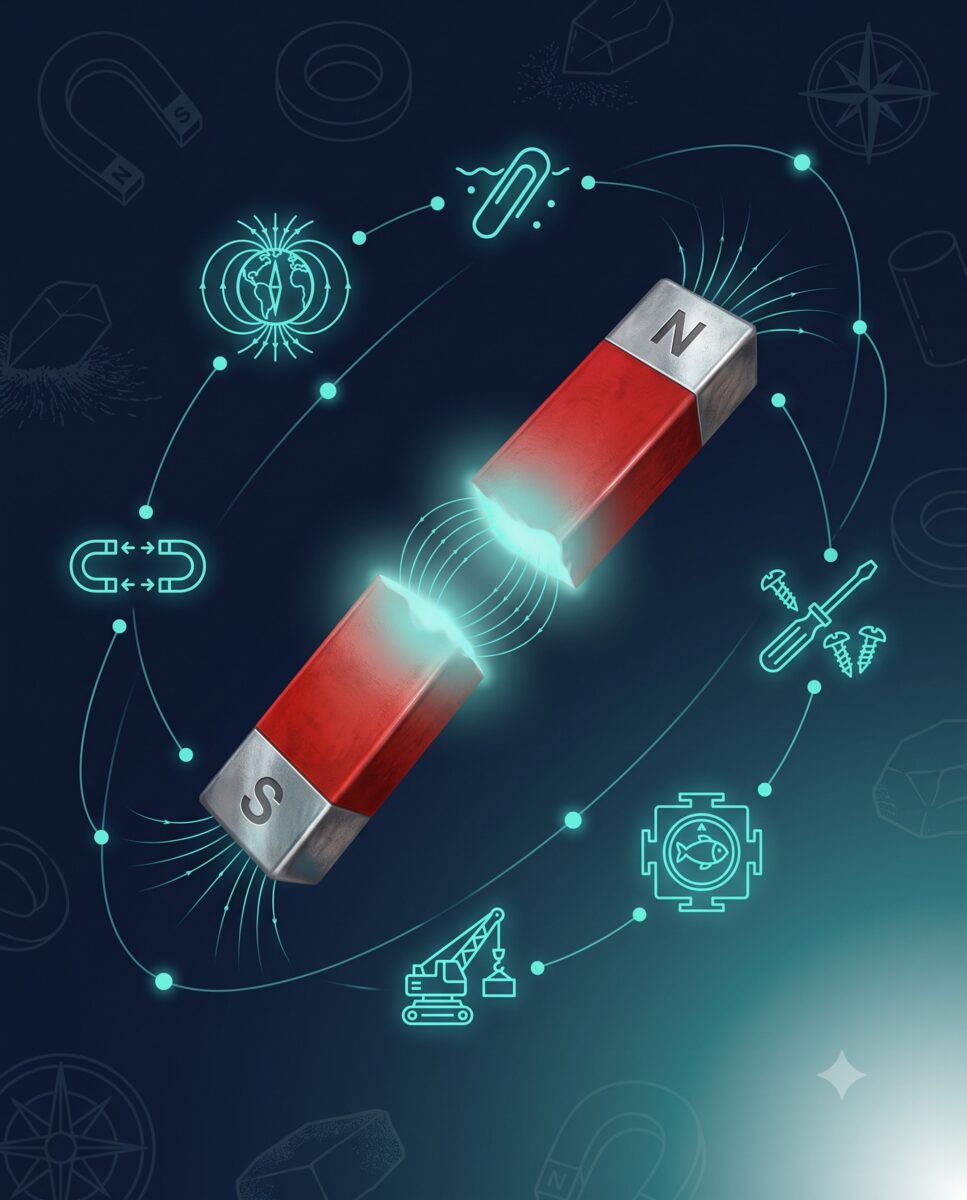
- Every magnet has two poles — North and South — where its pulling force is strongest.
- Unlike poles attract, like poles repel.
- Poles always come in pairs — snap a magnet in half and each new piece instantly gets its own full North and South pole.
- Earth itself behaves like a giant magnet, so a freely suspended magnet always settles pointing North-South — and a compass needle simply responds to this pull.
🔬 Repulsion Test, Single-Touch & Storage
- Repulsion is the sure test of a magnet — plain iron sticks to both poles, but only a true magnet pushes a like pole away.
- To make a DIY magnet: rub the same pole of a permanent magnet over an iron needle in one direction, then lift it up through the air and bring it back to the start — repeat 30–40 times.
- Store bar magnets in pairs, unlike poles on the same side, separated by wood, with soft iron keepers across the ends — heat, hammering or drops cause demagnetization.
Memory Cheat Code
Repulsion, not attraction, is the absolute proof of a magnet — a plain iron nail is "friendly" to both poles, but a true magnet fights back.
⚡ Sprint Facts — Exploring Magnets
3 Magnetic Metals
Iron, nickel, cobalt — aluminium, copper and gold are non-magnetic
Repulsion = Proof
Unmagnetized iron sticks to both poles; only a real magnet pushes a like pole away
Poles Come in Pairs
Break a magnet and each piece instantly becomes its own complete magnet
Earth = Giant Magnet
A freely suspended magnet always settles pointing North-South
6 Magnet Shapes
Bar, U-shaped, ring, cylindrical, disc and spherical are all artificial magnets
Lodestone Origin
Ancient Greeks found natural magnetic rock near Magnesia and called it magnetite
🔑 Key Terms
Lodestone
A naturally occurring magnetic rock (magnetite), first found near ancient Magnesia in Greece
Magnetic Compass
A device with a freely rotating magnetized needle that always settles pointing North-South
Electromagnet
A powerful, temporary magnet made by passing electric current through a coil around iron
Keepers
Soft iron pieces placed across a stored magnet's poles to help it hold on to its strength
Permanent Magnet
A material like iron, cobalt or a rare-earth metal that keeps its own magnetism on its own
Temporary Magnet
A material that acts magnetic only while inside another magnet's pull, like a stuck paperclip
🏆 Olympiad & Challenger Edge
Magnetic Fields
Beyond the syllabus term "magnetic effect", scientists describe the invisible zone of pull around a magnet as a magnetic field, mapped using tools like the PhET simulation to show its strength and direction.
Permanent vs Temporary
Permanent magnets (iron, cobalt, rare-earth metals) hold their own field forever. Temporary magnets, like a paperclip on a magnet, lose their pull the instant the main magnet is removed.
Electromagnets at Work
Scrapyard cranes use electromagnets because, unlike permanent magnets, they can instantly "drop" a heavy steel car simply by switching the current off.
The Origin Story
The word "magnet" comes from Magnesia, an ancient Greek region where naturally magnetic lodestone rocks were first discovered.
❌ Shiny metal = magnet?
Wrong. Magnets attract only iron, nickel and cobalt — aluminium, copper, silver and gold are all non-magnetic.
❌ Attraction proves it?
No. Plain iron is attracted to both poles of a magnet. Repulsion — pushing a like pole away — is the only sure test.
❌ Bar is the only shape?
No. Magnets also come as U-shaped, ring, cylindrical, disc and spherical — not just the classic bar.
❌ Magnets last forever?
False. Heating, hammering or dropping a magnet scrambles its structure and causes demagnetization.
⛵ Navigation
Ancient Indian sailors floated a magnetized iron fish, a matsya-yantra, in oil to find North — the ancestor of today's magnetic compass.
🚪 Everyday Fasteners
Hidden artificial magnets snap refrigerator doors, pencil boxes and bag flaps shut tight.
🏗️ Industrial Lifting
Scrapyard cranes use electromagnets to lift heavy steel cars — and drop them instantly by switching off the current.
🔧 Tool Magnetization
Mechanics magnetize a screwdriver's tip using the single-touch method, so tiny steel screws stick instead of falling into tight gaps.
🚨 Ball rolled away?
If a metal ball is repelled by a bar magnet, it must be a magnet itself — unmagnetized iron would be attracted, never pushed away.
🚨 Break it in half?
You never get an isolated North or South pole. Each broken piece instantly becomes its own complete new magnet.
🚨 Cardboard blocks it?
Wrong. A magnetic effect passes right through non-magnetic materials — wood, plastic, glass and cardboard included.
🚨 Storage mix-up
Store magnets with unlike poles on the same side plus soft iron keepers — not like poles touching each other.
🔗 Logic Chain — Making a DIY Magnet (Single-Touch Method)
Step 1 — Position the Needle
Lay the iron needle flat, with one pole of the bar magnet touching one end
Step 2 — Stroke to the End
Drag that same pole steadily along the needle's length, all the way to the far end
Step 3 — Lift and Return
Lift the magnet up through the air and bring the same pole back to the start — never drag it backward
Step 4 — Repeat 30–40 Times
Keep repeating the same pole, same direction, until the needle becomes a magnet
🦉
Mentor Byte
"Watch for the Attraction Trap — examiners love describing a shiny piece of metal pulled toward a bar magnet and then asking, 'Is the metal a magnet?' Never say yes right away. A plain, unmagnetized iron spoon happily jumps toward both the North and South poles — it's just 'friendly'. A true magnet has boundaries: flip your testing magnet around and it will fight back and push away. Repulsion is the absolute, undisputed proof of magnetism."
💛 Parent Tip
Grab two fridge magnets at home and let your child flip one around to feel it push the other away. Feeling repulsion with their own hands makes the concept stick far better than any diagram.