Class 7 | SST
Chapter 5 | The Rise of Empires
Aligned with CBSE | NCERT | School & Olympiad Standards
Focus on What Matters Most
The67Sprint
👑 Kingdom vs. Empire
- A kingdom is a smaller territory ruled by a king; an empire is a vast political unit made up of many smaller kingdoms and diverse populations ruled by a supreme emperor
- Empires require a massive professional army and a complex administration to collect taxes and maintain control
- Traders and craftsmen formed autonomous guilds called shrenis, sharing resources and setting their own rules
Shreni 🤝
⚔️ Rise of Magadha & the Mauryas
- Magadha rose to power through its fertile Ganga plains, abundant forests (timber & war elephants), and access to iron ore for weapons and ploughs
- Chandragupta Maurya founded the Maurya Empire around 321 BCE, guided strategically by Kautilya (Chanakya)
- Kautilya's Arthashastra outlines the Saptanga theory — the seven essential limbs needed to run a kingdom effectively
Saptanga 🏛️
☸️ Ashoka & Dhamma
- Ashoka expanded the empire but renounced violence after witnessing the destruction of the Kalinga War
- He adopted Buddhist teachings and promoted Dhamma — a universal moral law of peace, tolerance and duty — through edicts carved on rocks and pillars
- India's national emblem comes from Ashoka's Lion Capital at Sarnath; the Dharmachakra sits at the centre of our national flag
Memory Cheat Code
Saptanga = the 7 limbs of a state per Kautilya — King (Swami), Ministers (Amatya), Territory/People, Forts (Durga), Treasury (Kosha), Army, and Allies.
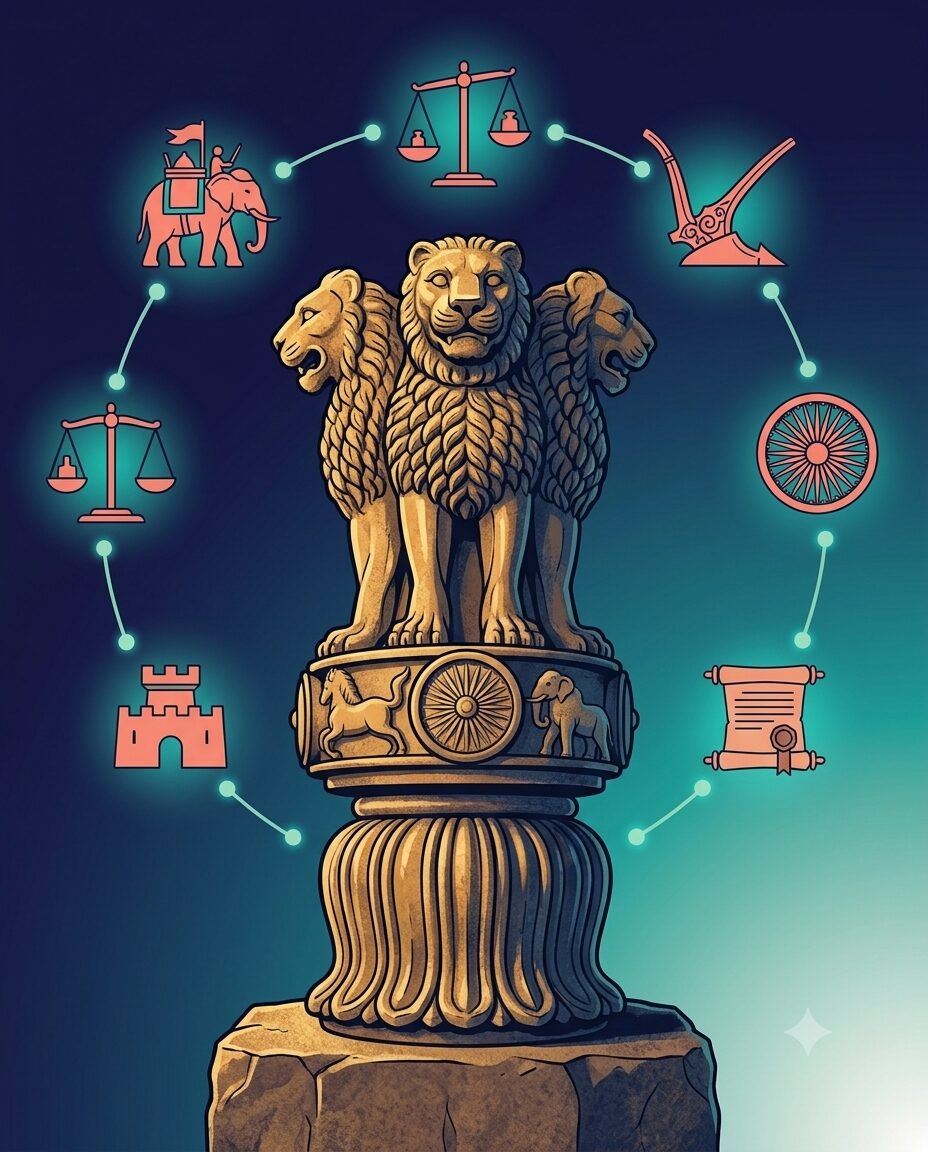
⚡ Sprint Facts — The Rise of Empires
327–325 BCE
Alexander the Great campaigns in northwest India, defeats King Porus, then retreats
~321 BCE
Chandragupta Maurya overthrows the Nanda Dynasty and founds the Maurya Empire
268–232 BCE
Reign of Emperor Ashoka, the most celebrated Mauryan ruler
~185 BCE
The Maurya Empire collapses and fragments into smaller kingdoms
Panini
Ancient scholar who composed the Ashtadhyayi — 3,996 sutras on Sanskrit grammar
Megasthenes
Greek diplomat in Chandragupta's court who wrote Indika, the first account of India
🔑 Key Terms
Empire
A large political unit made up of many smaller kingdoms, ruled centrally by an emperor
Tributary / Vassal
A regional ruler who submits to a supreme emperor and pays tribute as a sign of loyalty
Shreni (Guild)
A powerful, self-governing association of traders, craftsmen or agriculturists
Saptanga
Kautilya's theory of the seven essential parts of a state — King, Ministers, Territory, Forts, Treasury, Army, Allies
Dhamma
The Prakrit word for Dharma — Ashoka's universal code of conduct, tolerance and public duty
Satraps
Provincial governors left behind by Greek or Persian overlords to manage conquered territories
🏆 Olympiad & Challenger Edge
The Geopolitical Feedback Loop
Iron ore gave Magadha superior tools, creating food surplus that funded a standing army — conquests then brought control of trade routes, fuelling a self-reinforcing cycle of wealth and power.
Anatomy of Imperial Collapse
The empire's size caused communication lags with frontier provinces, while heavy taxation bred resentment — without a strong ruler like Ashoka, vassal kings fragmented the empire by 185 BCE.
Hellenistic–Indian Synthesis
Alexander's invasion sparked philosophical debate with Indian "Gymnosophists," laying early foundations for Indo-Greek cultural and artistic exchange.
❌ Prakrit = Brahmi?
Mix-up. Prakrit was the spoken language of Ashoka's edicts; Brahmi was the script used to write it on rocks and pillars.
❌ Alexander fought the Mauryas?
Wrong. Alexander invaded India and died before Chandragupta Maurya founded the Maurya Empire in 321 BCE.
❌ Ashoka forced Buddhism?
No. Dhamma was a secular moral code; Dhamma Mahamatras worked to ensure harmony among all sects — Jains, Ajivikas and Brahmans included.
🤝 Shrenis as Modern Networks
Ancient guilds worked like today's business chambers — competitors becoming collaborators by sharing tools, resources and knowledge.
🏰 Fortified Cities & Games
Pataliputra's walls, moats and drawbridges mirror the base-building strategies players use in tower-defense games to protect resources.
🛣️ Ashoka's Highways
Mauryan roads with wells and rest houses (sarais) for travellers were the ancient version of today's expressways.
🚨 Map Labeling Errors
Pataliputra sits near the confluence of the Ganga & Son rivers in modern-day Patna (Bihar) — not elsewhere in Uttar Pradesh.
🚨 "Tribute" ≠ Just Tax
Tribute means goods, money or livestock paid by a vassal state as a sign of submission and loyalty — not a simple tax.
🚨 Who Wrote the Arthashastra?
It was authored by Kautilya (Chanakya) — not Ashoka or Chandragupta. A common misattribution in exams.
🔗 Logic Chain — How Magadha Became an Empire
Step 1 — Iron Ore Advantage
Access to iron ore gives Magadha stronger ploughs and weapons
Step 2 — Surplus & Army
Better tools create food surplus, funding a massive standing army
Step 3 — Conquest & Trade
Magadha conquers neighbouring kingdoms and seizes major trade routes
Step 4 — The Mauryan Empire
Combined wealth and military power establish the mighty Mauryan Empire
🦉
Mentor Byte
"To truly master this chapter, don't just memorize the dates! Step into the shoes of an ancient merchant traveling the Dakshinapatha route. Understand why an emperor needed massive wealth (to feed his army) and how he generated it (through guilds and trade taxes). When studying Ashoka, look at a one-rupee coin in your pocket to see his Lion Capital, and remember that his ancient message of Dhamma, tolerance, and peace still serves as the heartbeat of our modern Indian democracy today."
💛 Parent Tip
Pull out a one-rupee coin together and find the Lion Capital. Ask your child to explain what the four lions stood for in ancient times — it turns an abstract symbol into something they can hold in their hand.