Class 6 | SST
Chapter 6 | The Beginnings of Indian Civilisation
Aligned with CBSE | NCERT | School & Olympiad Standards
Focus on What Matters Most
The67Sprint
What Is a Civilisation?
- An advanced society with government, urbanism (planned cities), trade, writing, shared culture, and — most important — productive agriculture.
- Agriculture is the foundation: surplus food frees people to build cities, trade, and invent writing.
Indus-Sarasvati Identity
- First called "Indus Valley Civilisation" — now "Indus-Sarasvati" since settlements stretch far beyond the Indus, along the dry Sarasvati (Ghaggar-Hakra) river.
- Called "Harappans" because Harappa was the first city excavated, in 1920-21.
City Layout
- Citadel: smaller, higher, western part — public and administrative buildings, like a City Hall or Parliament.
- Lower Town: larger, lower, eastern part — where ordinary people lived and worked.
- Streets followed a strict grid-iron pattern, crossing at right angles.
Water & Hygiene
- Private bathrooms connected to covered street drains with silt traps to stop clogging.
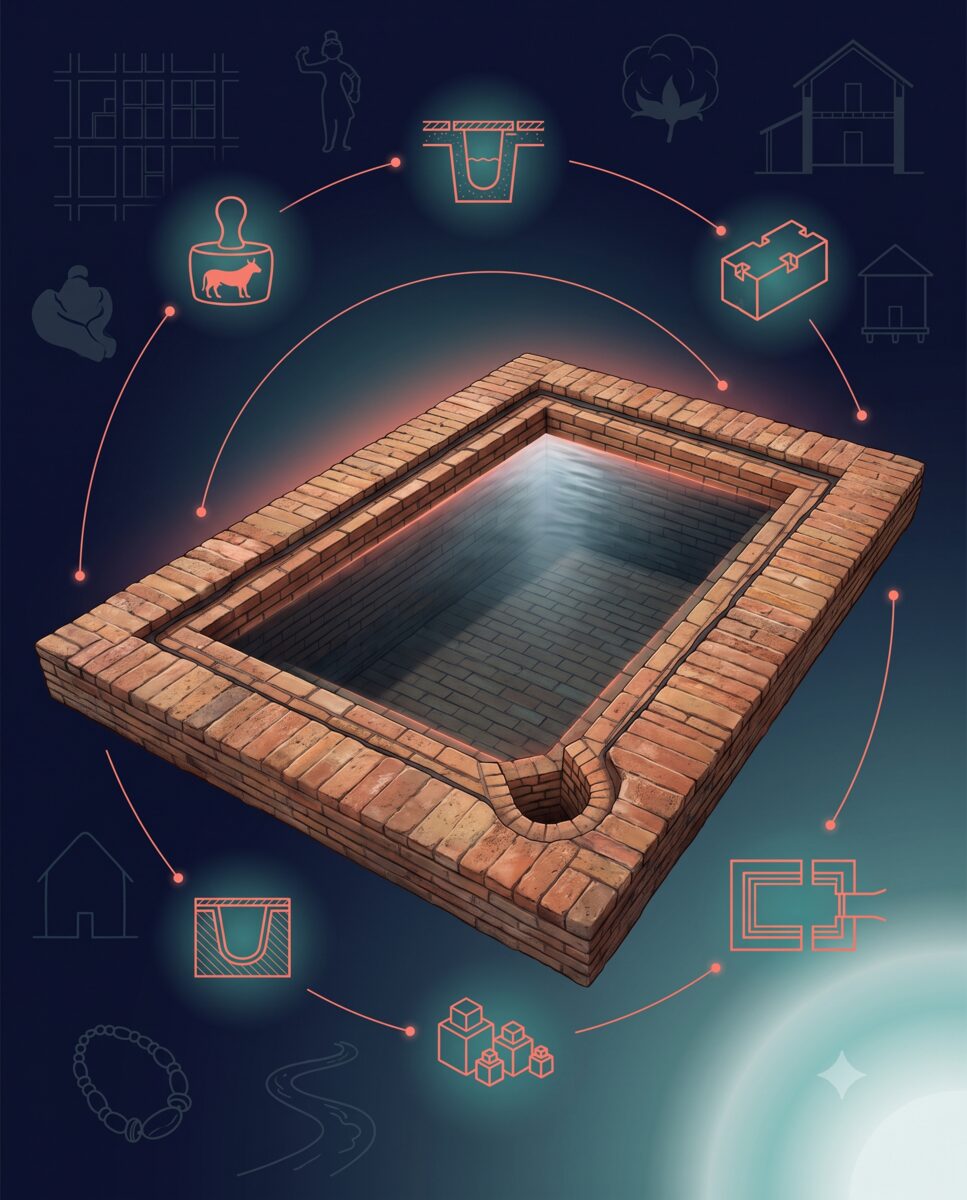
- Great Bath at Mohenjo-daro: waterproofed with natural bitumen, likely for rituals.
- Dholavira built massive reservoirs to harvest rainwater.
Diet & Farming
- Grew wheat, barley, and lentils; first in Eurasia to grow cotton for cloth.
- Domesticated cattle, sheep, and goats; also caught fish from rivers and the sea.
Trade Network
- Exported red carnelian beads, timber, and cotton; imported copper, which wasn't available locally.
- Massive tidal dockyard at Lothal (Gujarat) handled sea trade with Mesopotamia.
The Decline
- Peaceful de-urbanisation around 1900 BCE — not war or invasion.
- Climate change and shifting rivers dried up the Sarasvati, and people gradually moved to rural areas.
Pro-Tip
Ancient "Amazon Delivery": Merchants tied cargo with rope, sealed the knot with wet clay, and stamped it with a steatite seal. An unbroken seal meant the goods were safe.
Quick Recall — Sprint Facts
Timeline
c. 2600–1900 BCE
First City Dug Up
Harappa (1920-21)
Great Bath
Mohenjo-daro, waterproofed with bitumen
Dockyard
Lothal, Gujarat
Site Locations
Kalibangan-Rajasthan; Rakhigarhi-Haryana; Lothal & Dholavira-Gujarat
Key Metal
Bronze (copper + tin)
🔑 Civilisation
An advanced society with government, cities, trade, writing, and farming.
Citadel
The raised, western, administrative part of a Harappan city.
Steatite
Soft soapstone carved into trade seals.
Carnelian
A reddish semi-precious stone from Gujarat, exported as beads.
Bitumen
Natural tar used to waterproof the Great Bath.
Urbanism
Planned growth and management of cities and streets.
🏆 Olympiad & Challenger Edge
Brick Metrology
Bricks followed an exact 1:2:4 ratio (thickness:width:length), letting builders raise strong, multi-storey structures.
Tripartite Dholavira
Most cities had two parts, but Dholavira had three: Citadel, Middle Town, and Lower Town.
Archaeo-Chemistry (GC-MS)
Gas Chromatography-Mass Spectrometry on ancient pots proved Harappans cooked with dairy, ginger, turmeric, and bananas.
Binary & Decimal Weights
Chert weights followed binary (1,2,4,8,16) and decimal (160,200,320) scales; the 16th ratio was ~13.63g.
Peaceful Decline
Never write "invasion" or "war" — the decline was peaceful, caused by climate change and the Sarasvati drying up.
The Naming Update
Use "Indus-Sarasvati Civilisation," not just "Indus Valley" — this shows updated curriculum knowledge.
Great Bath Purpose
It wasn't a daily public pool — most homes had private bathrooms. The Great Bath was for rituals or royal use.
Bronze, Not Iron
Harappans were a Bronze Age society. Iron was unknown to them and appeared only centuries later.
Trade Was Barter, Not Coins
Harappans used standard weights and barter for trade — they did not use metal coins or paper money.
Tamper-Proof Delivery
Clay seals on cargo knots worked just like tamper-evident tape on today's delivery boxes.
City Sewer Systems
Silt traps in Harappan drains work exactly like modern manholes that catch waste before it clogs pipes.
Waterproofing Pools
Bitumen between bricks made the Great Bath leak-proof — like sealants used in pools today.
Smart City Grids
Grid-iron street planning is the same idea used in modern planned cities like Chandigarh.
Location Swaps
Lothal & Dholavira are in Gujarat; Kalibangan is in Rajasthan; Rakhigarhi is in Haryana.
Citadel Direction
Citadel is always west, smaller, higher. Lower Town is east, larger, lower. Don't reverse this.
Script Confusion
The Harappan script is still undeciphered — don't claim it tells us daily-life stories.
Meluhha Is Not Their Name
"Meluhha" is what Mesopotamians called this land in their own records — the Harappans never called themselves this.
Logic Chain — How the Harappan Civilisation Declined
Step 1
Tectonic shifts connect to rivers like the Sutlej and Yamuna changing course.
Step 2
Changed river courses lead to the Sarasvati losing its water and drying up.
Step 3
A dried Sarasvati combines with weaker monsoons to cause failing harvests.
Step 4
Failing harvests lead to peaceful migration from cities toward rural areas.
🦉
Mentor Byte
Never explain the Harappan decline with a single word like "drought." Show the full chain — geological trigger, then river change, then failed harvests, then migration. Examiners reward students who connect geography to history.
For Parents
Ask your child to trace the decline as a chain of causes, not one single event — this builds the reasoning examiners look for in 5-mark answers.