Class 6 | Science
Chapter 10 | Living Creatures: Exploring their Characteristics
Aligned with CBSE | NCERT | School & Olympiad Standards
Focus on What Matters Most
The67Sprint
Biotic & Abiotic World
- Our environment has biotic components — plants, animals, microorganisms — and abiotic components — sunlight, air, water, soil, temperature.
- Decomposers (fungi and bacteria) break down dead plants and animals, recycling nutrients back into the soil so new plants can grow.
8 Characteristics of Life
- To be classed as living, an organism must show: nutrition, growth, respiration, excretion, movement, response to stimuli, reproduction, and eventually death.
- A wooden log is made of biological cells, but it is non-living because its cellular metabolism and growth have permanently stopped.
Breathing vs. Respiration
- Breathing uses body organs like lungs or gills to physically move air in and out.
- Respiration is the process where living organisms take in oxygen and release carbon dioxide to produce energy for life activities.
Excretion in Plants & Animals
- Animals excrete urine and carbon dioxide as waste.
- Plants excrete by releasing oxygen (photosynthesis), carbon dioxide (respiration), and shedding excess water, resins, and gums.
Habitats & Adaptation
- A habitat gives an organism everything it needs to survive — food, water, shelter, and space.
- Adaptations are inherited features built for a habitat, like a cactus's water-storing stem or a polar bear's thick fur. Acclimatization is a short-term, temporary adjustment instead.
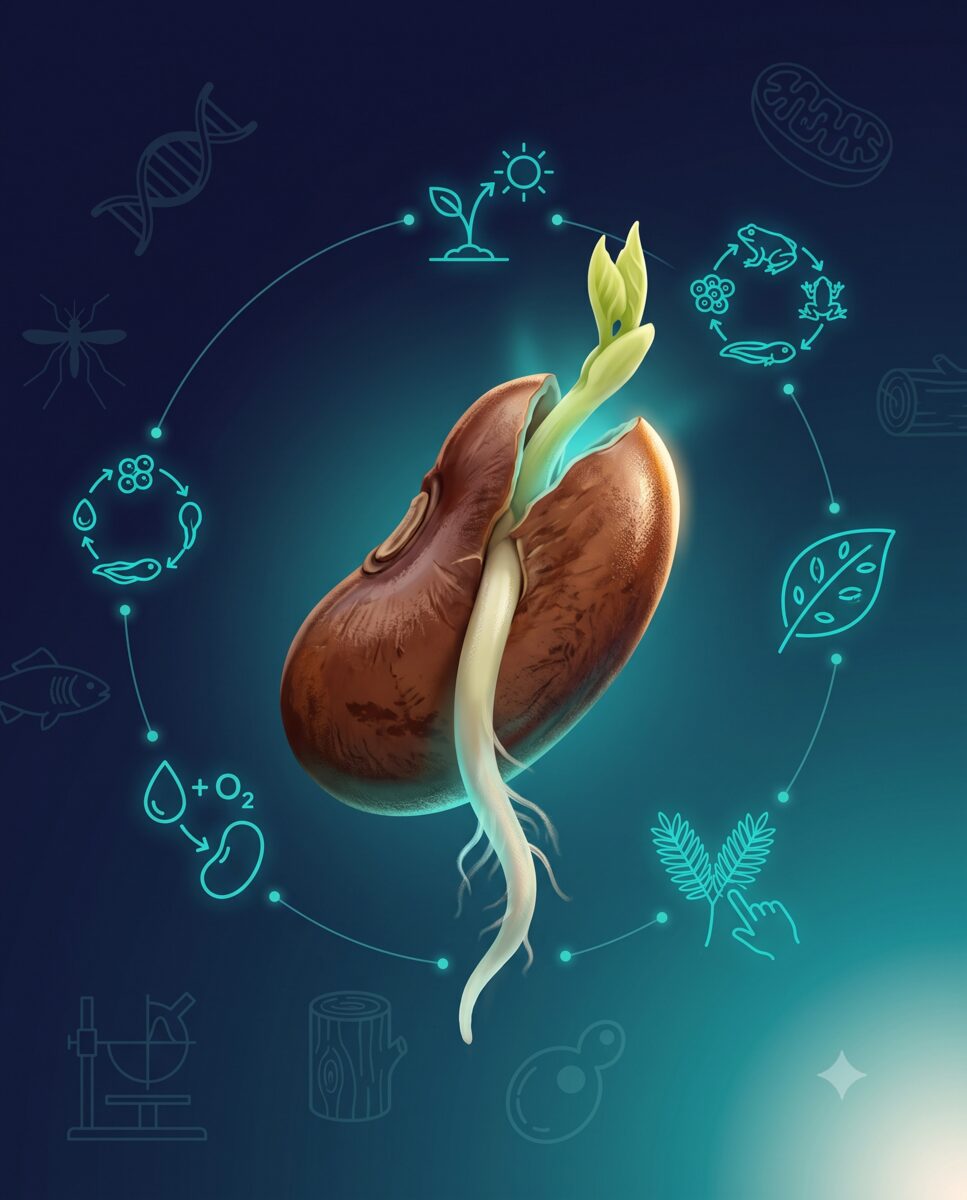
Quick Recall — Sprint Facts
Seed Needs
Moisture, oxygen, optimal temperature — not sunlight
Frog Life Cycle
Spawn → Tadpole → Froglet → Adult
Mosquito Life Cycle
Egg → Larva → Pupa → Adult
Tropism
Shoots bend to light (phototropism); roots grow down (gravitropism)
🔑 Key Terms to Know
Metamorphosis
A rapid, profound transformation an animal undergoes from larva to mature adult.
Phototropism
A plant's directional growth toward a light source to capture more sunlight.
Gravitropism
A plant's directional growth response to gravity — roots grow downward.
Spawn
The jelly-like cluster of eggs laid by frogs in freshwater.
🏆 Olympiad & Challenger Edge
J.C. Bose's Crescograph
Magnified plant movements 10,000 times, proving plants transmit electrical signals and show fatigue like animal muscles.
Yeast Fermentation
Yeast respires without oxygen, breaking sugar into carbon dioxide and ethanol — this is what makes bread dough rise.
Niche Partitioning
Tadpoles (aquatic herbivores) and adult frogs (amphibious carnivores) never compete for the same food or space.
Grain Storage Science
Farmers store seeds in dry, airtight, oxygen-poor silos to suppress respiration and keep them dormant for long periods.
Give the full definition
Never define "living" by movement or growth alone — list respiration, excretion, reproduction, and response to stimuli too.
Don't skip life cycle stages
Missing "Pupa" for mosquitoes or "Froglet" for frogs is an incomplete cycle and loses marks.
Keep breathing and respiration separate
Breathing is the physical exchange of gases; respiration is the internal process that releases energy from food.
Seeds are dormant, not dead
A seed is a living organism doing cellular respiration very slowly — not a non-living stone.
Baking Bread & Pizza Dough
Yeast breaks down sugar and releases carbon dioxide gas bubbles that make dough rise and turn fluffy.
Storing Dal & Chickpeas
Dry, airtight kitchen containers keep seeds asleep by removing the moisture and oxygen they need to sprout.
Dengue & Malaria Control
Emptying stagnant water breaks the mosquito life cycle by stopping larvae from breathing at the surface.
The Window-Sill Plant
A potted plant slowly leans toward a window — phototropism helping it capture more sunlight for photosynthesis.
"Once-living" ≠ living
A wooden log is made of biological cells, but its metabolism has permanently stopped — it's classified as non-living matter.
Moving cars are not alive
A car or cloud can move, but it cannot respire, grow, excrete, or reproduce — movement alone doesn't mean life.
Plants do move
Plants lack legs but show real movement through tropisms and nastic movements, like the touch-me-not plant folding its leaves.
Adaptation vs. acclimatization
Adaptation is a long-term inherited trait; acclimatization is a short-term, temporary bodily adjustment. Don't mix them up.
Logic Chain — How a Seed Wakes Up and Grows
Step 1
The dry seed absorbs water, which softens the seed coat and connects to the enzymes inside waking up
Step 2
Activated enzymes trigger cellular respiration, which connects to stored starch being converted into usable energy
Step 3
That released energy connects to the radicle (root) emerging and growing downward toward gravity
Step 4
At the same time, this leads to the plumule (shoot) emerging and growing upward toward light
🦉
Mentor Byte
"Stop memorizing definitions and start asking why. A seed looks like a pebble because it wears an armor-like coat to survive drought. A tadpole has a tail for swimming, but a frog needs legs for leaping — so the tail disappears. Every living creature is solving a real survival problem, and once you see the biology that way, it becomes a story you never forget."
For Parents
Try the yeast-balloon experiment at home — warm water, sugar, and yeast in a bottle with a balloon on top makes invisible respiration visible in minutes.