Class 7 | SST
Chapter 1 (Pt 2) | The Story of Indian Farming
Aligned with CBSE | NCERT | School & Olympiad Standards
Focus on What Matters Most
The67Sprint
🌾 What Is Agriculture?
- From Latin: agri (field) + culture (to cultivate)
- A vast system: crop cultivation, animal husbandry, forestry, pisciculture (fisheries) and apiculture (beekeeping)
- Over 75% of agricultural workers in rural India are women — sowing, weeding and threshing
- Agriculture contributes over 18% of India's GDP and employs about 46% of the workforce
🌦️ The Three Cropping Seasons
- Old Sanskrit names: kedāra (wet crops), haimana (winter crops), graiṣhmika (summer crops)
- Kharif (June–July, monsoon): rice, maize, cotton, groundnut
- Rabi (Oct–Dec, winter): wheat, barley, mustard, gram
- Zaid (short summer season): watermelon, cucumber, muskmelon
Kharif 🌧️
Rabi ❄️
Zaid ☀️
🪨 Six Major Soil Types
- Alluvial: river silt, nutrient-rich — rice, wheat
- Black: volcanic rock, holds moisture — cotton
- Red: iron oxide — ragi, groundnuts
- Laterite: heavy-rain leaching — tea, coffee, cashews
- Desert/Sandy: highly porous — bajra
- Mountain/Alpine: rocky, thin — apples, temperate fruits
🌱 Soil Formation & Conservation
- Soil forms over millennia through Weathering — the breakdown of Bedrock
- Humus (decayed organic matter) is the key ingredient for fertility
- Traditional protection: Crop Rotation, Multiple Cropping/Intercropping, Contour Ploughing
- Modern protection: Terracing and Afforestation
💧 Smart Water Management
- Northeast India: traditional Bamboo irrigation
- Drip irrigation drips water directly to plant roots — saves water
- Sprinklers spray water evenly over a field
- Government support: seeds, weather forecasts, research/training, cold storage, digital market access
🌿 Traditional to Sustainable Farming
- Gokrishi: cow-centred holistic farming
- Kulagar: traditional Goan homestead multi-tier farming
- Green Revolution (1960s–70s): HYV seeds and machinery achieved food security but caused soil degradation and groundwater depletion
- Sikkim became the world's first 100% organic state in 2014 by banning chemical fertilizers
- Beejamrit — ICAR-developed cow dung and urine paste that protects seeds and speeds germination
Sikkim 🌿
Beejamrit 🐄
Memory Cheat Code
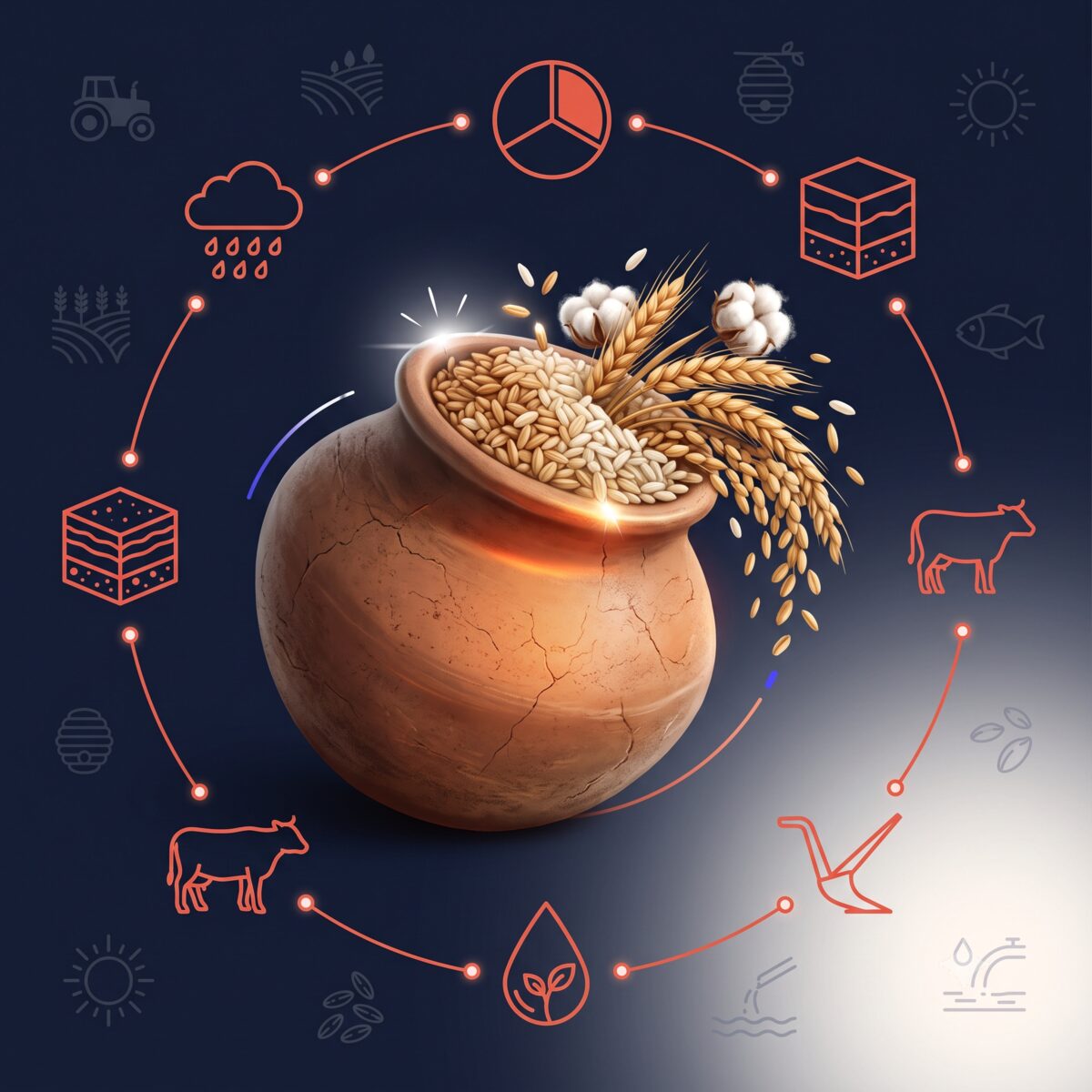
"Drink & Wear" — Rice drinks lots of water and wears a coat of mud (Kharif/Alluvial). Wheat wears a cool winter jacket and drinks little (Rabi).
🔑 Key Terms
Threshing
Removing the edible grain from the straw or husk, manually or by machine
Weathering
The breaking down of rocks and minerals into soil particles over millennia
Humus
Stable, dark decayed organic matter that keeps soil fertile and moist
Hydroponics
Growing plants in nutrient-rich water solutions without soil
Panchagavya
A fermented biofertilizer of five cow products that boosts crop growth
Beejamrit
An ICAR-developed cow dung and urine paste that protects seeds before sowing
Quick Recall — Sprint Facts
18% of GDP
Agriculture employs about 46% of India's workforce
2800 BCE
Intercropping practiced at Kalibangan, Rajasthan
15 Zones
India is divided into 15 distinct agroclimatic zones
2014 — Sikkim
World's first 100% organic state
75% Women
Share of agricultural workers in rural India who are women
3 Seasons
Kharif, Rabi and Zaid — India's farming rhythm
🏆 Olympiad & Challenger Edge
Vrikshayurveda's Seed Science
Ancient texts recommended organic seed-coating agents like maksika (honey) and bidanga (false black pepper) for optimal germination.
FAO Heritage Systems
The FAO recognises Kashmir's saffron farming, Odisha's forest-integrated agriculture, and Kerala's below-sea-level farming as globally significant.
Kautilya's Monsoon Formula
The Arthashastra defined a "good monsoon" by timing — one-third of rain at the start and end, two-thirds in the middle of the crop cycle.
Puran Sheti — Goa's Riverbank Farming
A 100% organic system relying on nutrient-rich river silt from monsoon floods, sharply declined after modern check-dams were built in 2005.
❌ Wheat = Kharif?
Wrong. Wheat is a Rabi (winter) crop needing cool growing weather and a dry harvest — planting it in a wet zone would rot the crop.
❌ Laterite = Red Soil?
No. Both look reddish from iron, but Laterite forms from intense leaching by heavy rain (Western Ghats/Goa); Red soil comes from weathered crystalline rock.
❌ Agriculture = Only Crops?
Incomplete. You must include allied activities: animal husbandry, forestry and fisheries, or you lose marks.
❌ Green Revolution = All Good?
If asked for its impact, you must also mention the negative side: soil degradation, chemical runoff and groundwater depletion.
❌ Kharif Sown in Winter?
No. Kharif crops are sown in June–July with the monsoon, not in the Oct–Dec Rabi sowing window — a common date mix-up in papers.
🍳 Kitchen Connections
Mustard oil comes from a Rabi crop; the watermelon you eat in summer is a Zaid crop.
🏢 Balcony Farming
Growing tomatoes or lettuce in apartment balconies using PVC pipes and mineral-rich water is Hydroponics — no soil needed.
👕 Your Cotton T-Shirt
Cotton thrives best in the moisture-retentive Black Soil of the Deccan plateau — the fibre in the shirt you're wearing.
🌊 The Ganga Basin Under Stress
Deep alluvial soils here face pressure from glacier melting, over-pumping of groundwater, and dam construction.
🍃 Neemastra in the Garden
A home spray boiled from neem leaves is a modern use of ancient Indian pest-control wisdom — no chemical bug spray needed.
🚨 Incomplete Definitions
Defining "Agriculture" as just "growing crops" loses marks — always include livestock, forestry and fisheries.
🚨 One-Sided Green Revolution
Only praising increased food production is incomplete — examiners expect the ecological costs too: soil toxicity and groundwater depletion.
🚨 Red vs Laterite Mix-Up
A classic confusion — remember Laterite forms from heavy leaching rain and suits tea/cashew; Red soil suits millets.
🚨 Season-Crop Swaps
Mixing up which crop belongs to which season is the #1 way marks are lost — always link climate, soil and crop together.
🚨 Traditional ≠ Backward
Don't dismiss systems like Gokrishi or Kulagar as outdated — the chapter frames them as sustainable wisdom worth combining with modern tech.
Logic Chain — How Indian Farming Transitioned
Step 1 — Traditional Farming
Local seeds, rain-fed fields and cow-manure systems like Gokrishi connect to a self-sustaining rural economy
Step 2 — The Green Revolution
In the 1960s, HYV seeds, heavy machinery and chemical fertilizers connect to a sudden jump in food production
Step 3 — Ecological Crisis
Decades of chemical use connect to groundwater depletion, toxic soils and health risks for farming communities
Step 4 — Sustainable Synthesis
Recognising the crisis connects to blending ancient wisdom like neem-pesticides with precision tech like drip irrigation
🦉
Mentor Byte
"Do not memorise crop lists by rote. Ask instead: what does this crop drink, and what does it wear? Rice drinks deeply and wears a coat of mud — Kharif, Alluvial soil. Wheat sips lightly and wears a winter jacket — Rabi, well-drained soil. Connect the climate to the soil, and the soil to the crop, and the chapter organises itself."
💛 Parent Tip
At your next meal, ask your child to name which season each ingredient on the plate belongs to — the wheat roti, the rice, the seasonal vegetable. Turning dinner into a quick sorting game locks in the Kharif/Rabi/Zaid distinction far better than a written list.