Class 6 | Science
Chapter 7 | Temperature and its Measurement
Aligned with CBSE | NCERT | School & Olympiad Standards
Focus on What Matters Most
The67Sprint
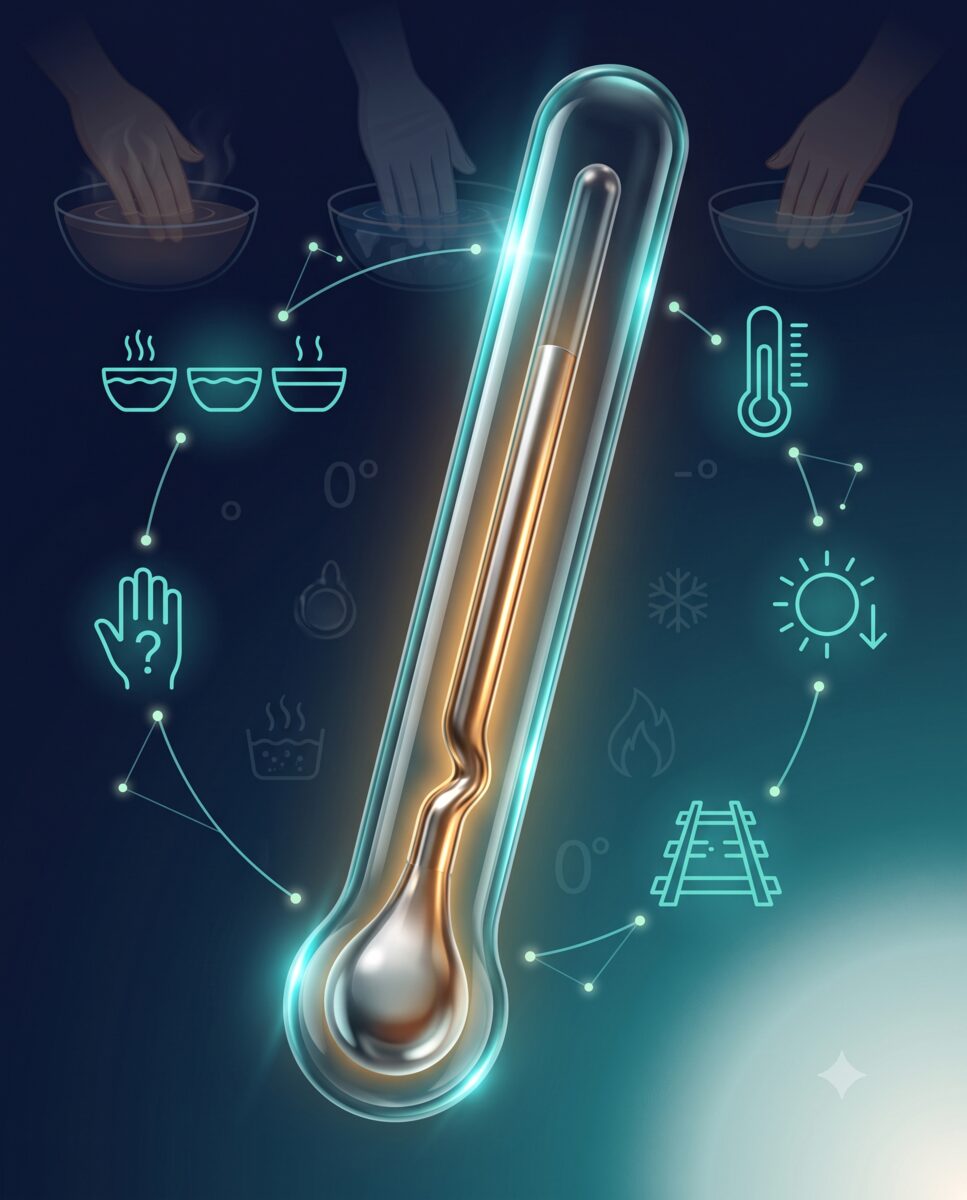
Temperature vs. Heat
- Temperature is a reliable measure of the degree of hotness or coldness of a body — human touch is relative and easily fooled.
- Heat is a form of energy that flows from a hotter object to a cooler object.
- Hold ice, then touch tap water — it feels warm! Your skin only compares against what it just felt.
Clinical Thermometer
- Measures human body temperature only, range 35°C to 42°C.
- Has a "kink" (constriction) near the bulb that stops the mercury falling back automatically.
- Must be shaken with sharp jerks before use, to force the mercury below 35°C through the kink.
- Normal body temperature: 37.0°C or 98.6°F.
Laboratory Thermometer
- Wider range, typically −10°C to 110°C, for science experiments.
- Has no kink — must be read while still fully immersed in the liquid.
- Removing it to look closely causes the reading to drop instantly.
Temperature Scales
- Celsius (°C) and Fahrenheit (°F) are used for everyday measurement.
- Kelvin (K) is the SI unit used in science — written without a degree symbol.
- Boiling point of water = 100°C; freezing point = 0°C.
Quick Recall — Sprint Facts
Normal Body Temp37.0°C / 98.6°F
Clinical Range35°C–42°C (94°F–108°F)
Lab Thermometer Range−10°C to 110°C
Absolute Zero0 K = −273.15°C
🔑 Key Terms to Know
Temperature
The degree of hotness or coldness of a body, measured with a thermometer
Heat
A form of energy that flows from a hotter object to a cooler one
Kink
A small bend near the bulb of a clinical thermometer that stops mercury falling back on its own
Thermal Expansion
The tendency of a liquid like mercury to change volume when heated — the working principle of thermometers
Least Count
The value of one small division on a scale, found by dividing the gap between two marks by the number of divisions
Kelvin
The SI unit of temperature, written as K with no degree symbol
🏆 Olympiad & Challenger Edge
Absolute Zero
0 Kelvin (−273.15°C) is the lowest theoretical temperature possible — all molecular motion stops completely at this point.
Scale Conversions
Celsius to Kelvin: add 273.15. Celsius to Fahrenheit: F = (C × 9/5) + 32. At −40°, both scales read the same number.
Altitude & Boiling Point
In Shillong, water can boil at 98°C instead of 100°C — lower atmospheric pressure at higher altitude means less energy is needed to boil.
Least Count Calculations
If 20 divisions sit between 10°C and 20°C, each division = 0.5°C. Five divisions above 20°C reads 22.5°C — not a guess, a calculation.
❌ Reading a lab thermometer out of the liquid
Wrong — it has no kink, so the reading drops the instant it's removed. It must be read while fully immersed and vertical.
❌ Washing a clinical thermometer in boiling water
Wrong — boiling water is 100°C, far past its 42°C limit, and the glass will shatter from rapid expansion.
❌ Holding the thermometer by the bulb
Wrong — your hand's heat transfers into the liquid and artificially raises the reading.
❌ Writing the SI unit as "°K"
Wrong — Kelvin is written without a degree symbol, simply as K, e.g. 300 K.
🌡️ Infrared Thermometers
Non-contact devices used during outbreaks like COVID-19 to check for fever without touching the patient, preventing cross-infection.
🚂 Railway Track Gaps
Small gaps are deliberately left between railway tracks so the iron can expand in summer heat without buckling.
🍳 Cooking Safely
Measuring food temperature ensures harmful bacteria are killed and food is properly cooked.
🇮🇳 Anna Mani, Weather Woman of India
Built vital meteorological instruments that reduced India's reliance on foreign technology.
🚨 Not shaking the clinical thermometer first
Skipping the sharp jerks before use leaves old mercury above 35°C, causing an inaccurate reading.
🚨 Missing units or spacing
Always leave a space between number and unit, e.g. "37.0 °C" — and never write Kelvin with a degree symbol.
🚨 Confusing Heat and Temperature
Heat is energy in transit between objects; temperature is the degree of hotness of one object itself. They are not the same measurement.
🚨 Skipping algebra steps in scale conversions
When solving for equal Celsius-Fahrenheit values, show each step (set F=C, then −0.8x=32) rather than jumping straight to −40°.
Logic Chain — How a Thermometer Reads Body Temperature
Step 1
Body heat connects to the thermometer bulb, which contains mercury sensitive to temperature change.
Step 2
The mercury heats up and connects this energy to thermal expansion, rising up the narrow tube.
Step 3
The kink connects the risen mercury to a locked reading, stopping it from falling back once removed.
Step 4
The locked mercury level connects to the scale markings, giving an accurate final temperature reading.
🦉
Mentor Byte
A good measurement is only as honest as the tool that takes it — the hand lies, the thermometer does not. Teach the least count before the reading, and the number will always mean something.
For Parents
Let your child shake a real clinical thermometer (if you have a glass one) before use — the physical action makes the "kink" concept unforgettable.