Class 6 | SST
Chapter 7 | India's Cultural Roots
Aligned with CBSE | NCERT | School & Olympiad Standards
Focus on What Matters Most
The67Sprint
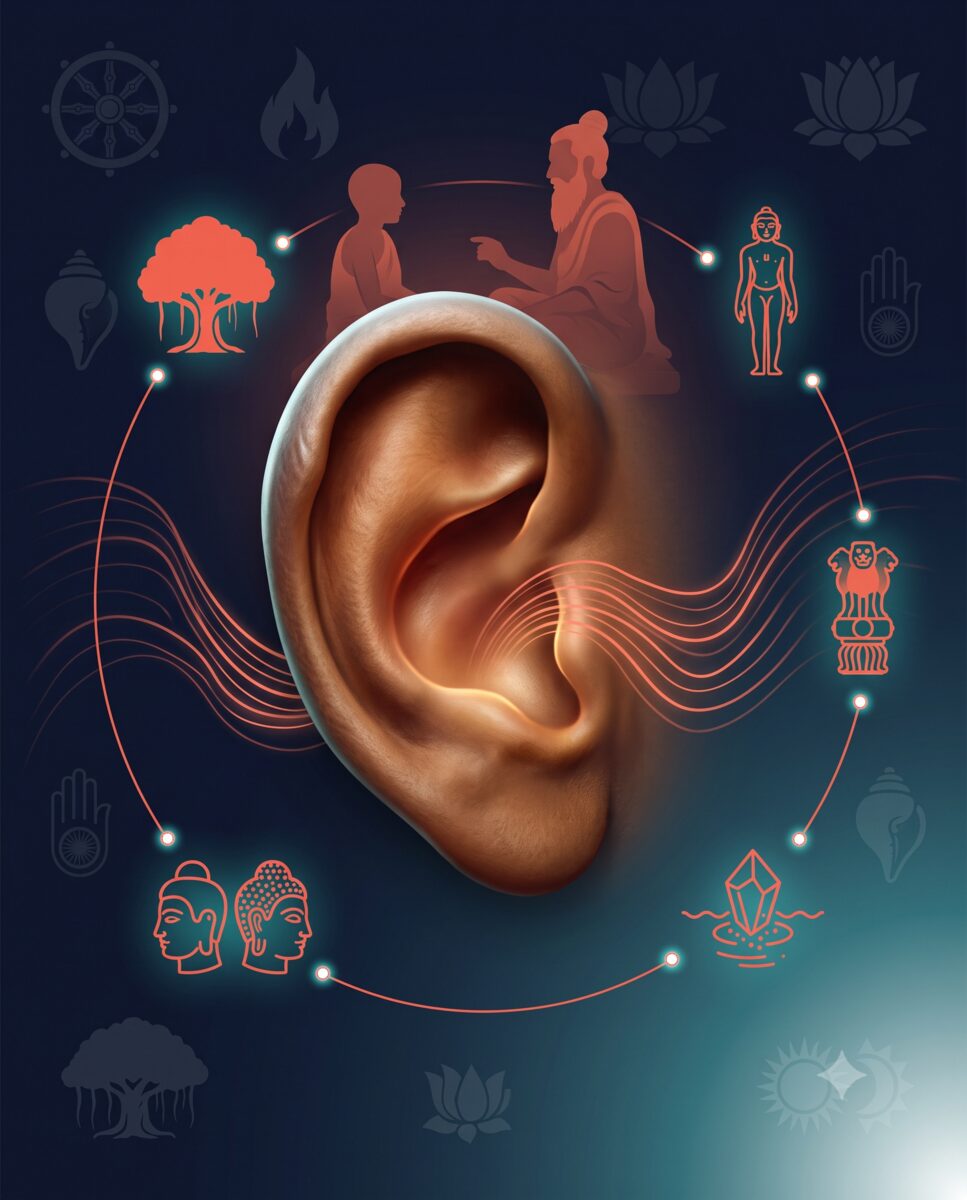
📖 Shruti & Smriti — The Vedic Corpus
- The four Vedas — Rig, Sama, Yajur, Atharva — form the foundation of ancient Indian thought; "Veda" means knowledge
- Shruti ("that which is heard") — the Vedas, preserved strictly by oral recitation for thousands of years, never originally written
- Smriti ("that which is remembered") — literature like the Ramayana and Mahabharata, passed down through narration
- UNESCO recognised Vedic chanting in 2008 as a masterpiece of the oral and intangible heritage of humanity
🕉️ The Upanishads — Inner Inquiry
- Later Vedic texts shifted focus from external rituals (yajnas) to deep philosophical inquiry
- Atman — the individual soul; Brahman — the universal essence; the two are one (Tat Tvam Asi)
- Nachiketa asked Yama, God of Death, about the soul and life after death (Katha Upanishad)
- Uddalaka taught his son Shvetaketu using salt dissolved in water — invisible, yet present in every drop, just like Brahman
☸️ Buddhism & Jainism — New Paths
- Emerged in the 1st millennium BCE as simpler, ethical responses to costly Vedic rituals
- Buddhism — founded by Siddhartha Gautama; taught the Four Noble Truths, the Eightfold Path, and the Middle Path
- Jainism — led by Mahavira, the 24th Tirthankara; core principles are Ahimsa, Anekantavada, and Aparigraha
- Ahimsa means avoiding violence in thought, word, and deed — not just physical non-violence
🏛️ Ashoka's Dhamma & Ancient Science
- After the Kalinga War, Emperor Ashoka gave up conquest by war and ruled through Dhamma — moral duty and righteousness
- He inscribed his messages on stone pillars across the empire; the Sarnath Lion Capital is now India's National Emblem
- Aryabhata proved the Earth rotates on its axis, calculated Pi as ~3.1416, and explained eclipses as shadows, not demons
Sarnath 🦁
Aryabhata 🔢
Memory Cheat Code
Salt in Water = Brahman is invisible but everywhere — taste it in every drop, just as the universal essence fills the whole universe.
Quick Recall — Sprint Facts
4 Vedas
Rig, Sama, Yajur, Atharva — the oldest sacred texts of India
24th Tirthankara
Mahavira — not the founder, but the 24th in a long Jain lineage
Bodh Gaya
Where Siddhartha Gautama attained enlightenment under a pipal tree
Kalinga War
Triggered Ashoka's shift from conquest by war to conquest by Dhamma
Pi ≈ 3.1416
Aryabhata's accurate calculation, alongside Earth's rotation and eclipses
UNESCO 2008
Vedic chanting recognised as oral and intangible heritage of humanity
🔑 Key Terms
Shruti
"That which is heard" — eternal truths preserved orally, like the Vedas
Smriti
"That which is remembered" — literature passed down by narration, like the Epics
Ahimsa
Strict non-violence in thought, word, and deed toward all living beings
Anekantavada
The Jain principle of "many-sidedness" — truth has multiple valid perspectives
Aparigraha
Non-attachment and limiting worldly possessions to live simply
Stupa
A dome-shaped Buddhist monument built to house sacred relics
🏆 Olympiad & Challenger Edge
The Charvaka School
A radical materialist school that rejected the Vedas, karma, and rebirth — trusting only direct perception (pratyaksha) as valid knowledge.
Ashoka's Global Ties
The Kandahar Rock Edict was bilingual — Greek and Aramaic — proving the Mauryan Empire's deep diplomatic links with the Hellenistic world.
The Fig Seed Metaphor
Uddalaka asked Shvetaketu to break open a banyan seed. Finding "nothing" inside, he explained the entire tree grows from that invisible essence — just as the universe grows from Brahman.
Mathura vs Gandhara Art
Mathura used red sandstone with rounded, indigenous forms; Gandhara used grey schist with Hellenistic wavy hair and realistic drapery.
❌ Vedas were written books?
No. The Vedas were preserved strictly through oral recitation for over 100 generations before ever being written down.
❌ Jainism = branch of Buddhism?
Wrong. Jainism is an independent, ancient tradition. Mahavira was its 24th Tirthankara, not the first founder.
❌ Ahimsa = no hitting only?
Incomplete. Ahimsa means avoiding harm in thought, word, and deed — not just physical violence.
❌ Sarnath = Bodh Gaya?
Different places. Buddha attained enlightenment at Bodh Gaya; the Ashokan Lion Capital stands at Sarnath.
🧹 Practising Aparigraha
Decluttering your room and donating outgrown toys or clothes is the 2,500-year-old Jain principle of non-possession in action today.
🏏 Anekantavada on the Field
Like a cricket umpire checking multiple camera angles, understanding a friend's different but valid view is Anekantavada in daily life.
👵 Grandma's Recipe
Learning a family recipe purely by watching and listening — no cookbook — mirrors exactly how the Vedas were preserved orally for millennia.
⚖️ The Middle Path Today
Balancing study, play, and rest — instead of extremes of either — reflects the Buddha's teaching of the Middle Path in everyday student life.
🚨 One-reason decline answers
Never blame invasions for the Harappan decline in this chapter's context — and for "decline" questions here, cite multiple ecological factors, not just one.
🚨 Smriti vs Shruti mix-up
Shruti = "heard," revealed and eternal (the Vedas). Smriti = "remembered," passed down by narration (the Epics). Don't swap them.
🚨 Ashoka's edicts = only religion?
Wrong. His edicts rarely mention the Buddha directly — they focus broadly on moral duty, tolerance, and social welfare for all.
🚨 Tribal beliefs = primitive?
Incorrect assumption. Tribal traditions like Donyipolo show complex cosmology, and deities like Lord Jagannath show deep influence on mainstream Hinduism.
Logic Chain — How the Shramanic Revolution Began
Step 1
Later Vedic rituals (yajnas) grow increasingly complex and costly, connecting to widespread frustration among common people
Step 2
This frustration leads thinkers to turn inward, connecting to the rise of Upanishadic inquiry into Atman and Brahman
Step 3
Upanishadic ideas of simpler, inner truth connect to the emergence of Buddhism and Jainism as ethical alternatives
Step 4
Buddhism and Jainism's rejection of costly ritual and rigid caste leads to their rapid spread as the Shramanic Revolution
🦉
Mentor Byte
"Students often treat ancient philosophies as a list of unrelated names. Draw a single thread instead: the Upanishads asked why rituals felt hollow, and Buddhism and Jainism answered with a simpler ethical life. Once a child sees that both movements rejected the same costly rituals — just with different solutions — the whole chapter clicks into one coherent story instead of scattered facts."
💛 Parent Tip
Ask your child to give away one toy or item they've outgrown this week, and explain that they're practising Aparigraha — the same 2,500-year-old idea Mahavira taught. Practising it once makes the term unforgettable.