Class 7 | SST
Chapter 6 | The Age of Reorganisation
Aligned with CBSE | NCERT | School & Olympiad Standards
Focus on What Matters Most
The67Sprint
Age of Reorganisation
- After the Maurya Empire fragmented (~185 BCE), the subcontinent entered the "Age of Reorganisation" — 2nd century BCE to 3rd century CE
- This was not a "Dark Age" but a period of new regional kingdoms, cultural fusion, and booming trade
- Pushyamitra Shunga founded the Shunga dynasty and revived the ashvamedha yajna to declare supremacy
- Shungas patronized early Buddhist art, contributing to the Bharhut Stupa's stone railings
Deccan & Eastern Powers
- Satavahanas (Andhras) flourished in the Deccan through maritime trade — ship motifs appear on their coins
- Satavahana kings used their mothers' names in their titles (e.g. Gautamiputra Satakarni) to show her influence in the kingdom
- They supported rock-cut architecture like the Karla and Pitalkhora caves
- In Kalinga, the Chedi king Kharavela — a devoted Jain follower — built the Udayagiri-Khandagiri caves and left the Hathigumpha inscription
Southern Triad & Sangam Age
- Cholas, Cheras, and Pandyas ruled the south, growing rich through maritime trade with Rome
- Chola King Karikala built the Grand Anicut (Kallanai) on the Kaveri, still irrigating farmland today
- Sangam literature — the oldest Tamil literature — was compiled by assemblies of poets on love, heroism, and justice
- The epic Silappadikaram tells the story of Kannagi and Kovalan, prizing justice above all
Cholas 🌊
Cheras 🌿
Pandyas 🐚
Memory Cheat Code
Gandhara = Grey — grey-black schist, Greco-Roman drapes. Mathura = Red — red sandstone, pure Indian style.
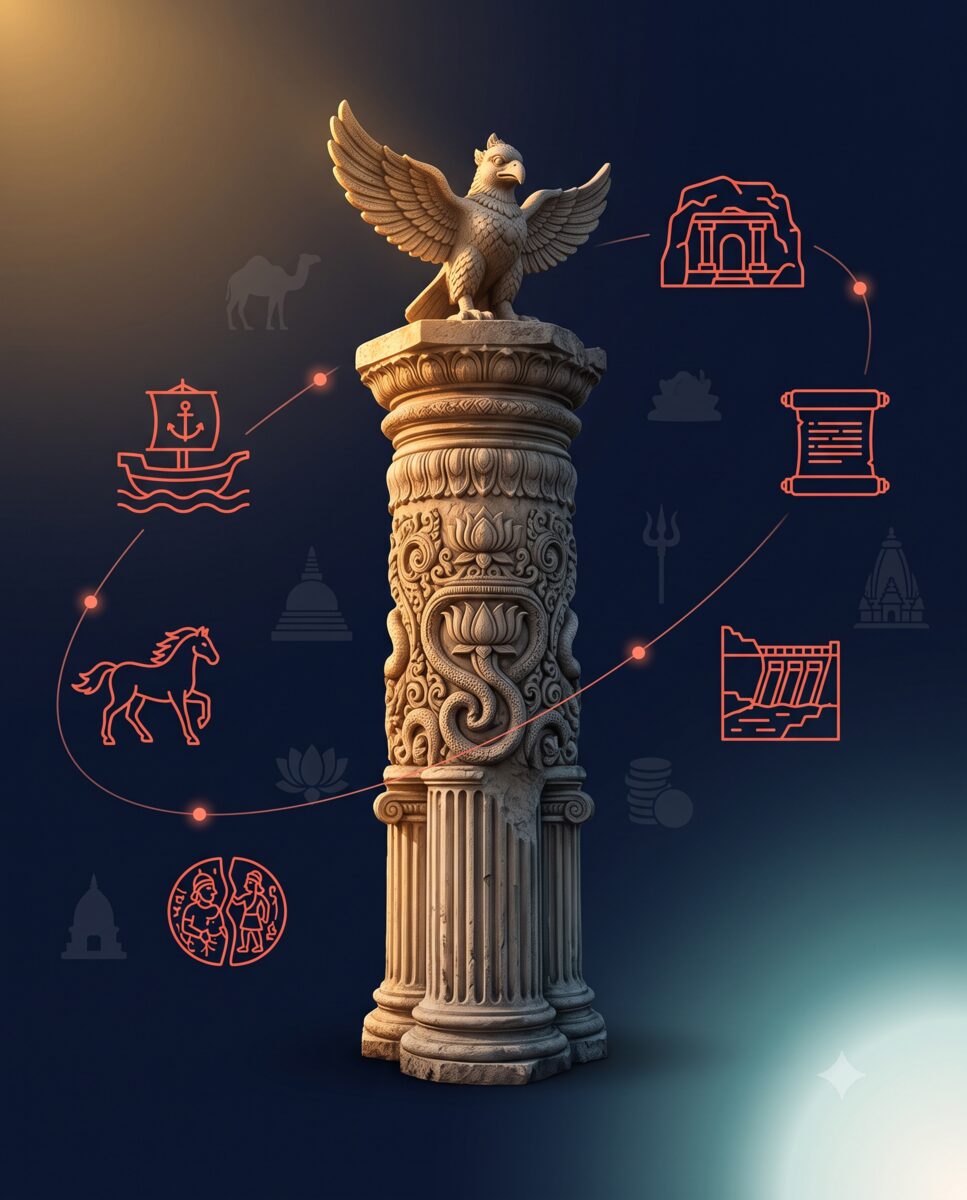
Sprint Facts — Age of Reorganisation
2nd C BCE – 3rd C CE
Timeframe of the Age of Reorganisation
Shaka Samvat
Calendar of the Shakas (Indo-Scythians) — 78 years behind the Gregorian calendar
Kanishka
Kushana king who controlled the Silk Route
Karikala
Chola king who built the Grand Anicut (Kallanai)
Gandhara Art
Grey-black schist, Greco-Roman and Indian blend
Mathura Art
Red sandstone, distinct indigenous Indian style
🔑 Key Terms
Ashvamedha Yajña
A supreme Vedic horse-sacrifice ritual performed by kings to declare territorial supremacy
Sangam
Great assemblies of Tamil poets in South India whose works form the region's oldest literature
Rock-Cut Architecture
Carving rooms, panels, and temples directly out of natural rocky hillsides using chisels and hammers
Satrap
Regional governors left behind by Alexander the Great who later became independent Indo-Greek rulers
Cultural Assimilation
Foreign invaders integrating into Indian society, adopting local religions and blending art styles
Guild
An organised association of merchants or craftspeople with its own internal rules
🏆 Olympiad & Challenger Edge
Matrilineal ≠ Matriarchy
Analyse the difference between matrilineal descent (tracing royal titles through the mother's line, as with the Satavahanas) and a true matriarchy — using Queen Gautami Balashri's Nashik inscription as evidence of maternal influence within a patriarchal state.
Numismatic Legitimation
Kushana coins featuring Buddha, Shiva, and Greek script together were a deliberate political tool — legitimising rule and unifying a diverse, pluralistic empire, not merely decorative art.
Brahmi Numerals at Naneghat
Numeral symbols in the Naneghat cave inscriptions resemble today's number shapes — evidence that modern numerals ultimately originated in India.
The Pitalkhora Goldsmith
A yaksha sculpture at Pitalkhora carries an inscription naming its maker, Kanahadasa, a goldsmith — proof that era's artisans moved fluidly between stone and metal work.
❌ "Dark Age" after the Mauryas?
No — always use "Age of Reorganisation." It was a time of new kingdoms, trade growth, and cultural fusion, not collapse.
❌ Gandhara and Mathura mixed up?
Gandhara = grey-black schist + Greco-Roman influence. Mathura = red sandstone + pure Indian style. Don't swap the materials.
❌ "Foreigners just took over"?
Incomplete. Always use "cultural fusion" or "assimilation" — back it with the Heliodorus Pillar or Kushana coins blending Greek script with Indian gods.
❌ BCE/CE timeline slip-ups
This era spans 2nd century BCE to 3rd century CE — crossing from BCE to CE. Keep the direction of counting clear on any timeline.
📅 Our National Calendar
The Shaka Samvat, developed by the Indo-Scythians during this era, was adopted as India's official National Calendar in 1957.
🌾 A 2,000-Year-Old Dam Still Working
The Grand Anicut (Kallanai), built by Chola King Karikala near Srirangam island, still irrigates Tamil Nadu farmland today.
🐫 The Ancient Silk Route
The Kushanas secured trade routes moving spices, silk, and gold between India, China, and Rome — much like global shipping networks today.
🧘 Yoga in Everyday Life
The Yoga Sutras, compiled by Patanjali during the Shunga period, are still widely practised in fitness and wellness today.
🚨 Wrong king, wrong dynasty
Karikala → Cholas. Kharavela → Chedis. Kanishka → Kushanas. Mixing these up is a common and costly error.
🚨 Map placement of the Southern Triad
Cheras sit in the west (Kerala), Pandyas in the deep south (Madurai), Cholas in the east (Kaveri delta) — don't swap positions.
🚨 Naming Satavahana society "matriarchy"
Kings used their mothers' names to show her influence and status — the kings still ruled. Describe it as respect for royal mothers, not female rule.
🚨 Vague answers on assimilation
Don't just say "foreigners assimilated" — name an artefact. The Heliodorus Pillar or Kushana coins are the proof examiners look for.
🔗 Logic Chain — From Mauryan Collapse to Cultural Fusion
Step 1
The centralised Mauryan Empire disintegrates around 185 BCE
Step 2
Regional powers rise — Shungas, Satavahanas, Chedis — and the northwest opens to foreign incursions
Step 3
Indo-Greeks, Shakas, and Kushanas settle and adopt indigenous traditions
Step 4
Trade flourishes along the Silk Route, birthing syncretic art (Gandhara/Mathura) and Sangam literature
🦉
Mentor Byte
"History now asks your child to move from 'who ruled where' to 'how cultures blended.' The students who score full marks don't just claim assimilation — they prove it with an artefact. Teach the 'Claim + Artefact' rule: name the Heliodorus Pillar, a Kushana coin, or the Hathigumpha inscription every time. Diversity here isn't a broken puzzle — it's the engine of the era's civilisation."
💛 Parent Tip
Trace the Silk Route on a map together and mark India, China, and Rome. Ask your child what might have travelled along it both ways — goods, but also ideas, art styles, and gods. This visual makes "cultural fusion" click far better than the term alone.