Class 6 | Science
Chapter 6 | Materials Around Us
Aligned with CBSE | NCERT | School & Olympiad Standards
Focus on What Matters Most
The67Sprint
Matter & Materials
- Matter is anything that occupies space and has mass — everything around us is made of one or more materials (wood, glass, plastic, metal).
- A single material can make many objects (plastic → buckets, toys, pipes); a single object can be made of many materials (a pen has plastic, metal, ink).
- Materials are grouped as solids, liquids, and gases, and we sort them further by their properties for convenient study and storage.
Appearance, Hardness & Flexibility
- Lustre: shiny materials (mostly metals like iron, copper, aluminium, gold) are lustrous; metals lose shine due to air and moisture, but true lustre shows on a freshly cut or sandpapered surface.
- Hardness: soft materials compress or scratch easily (cotton, sponge); hard materials resist compression (iron, wood).
- Flexibility: some materials bend easily (rubber, cloth) while others are rigid (glass, steel rod) — a property added to this year's syllabus alongside states of matter.
Solubility & Transparency
- Soluble solids (salt, sugar) mix well and disappear in water; insoluble solids (sand, chalk powder) settle or float without disappearing.
- Liquids that mix well with water are miscible (vinegar, lemon juice); those that form a separate layer are immiscible (mustard oil, kerosene).
- Transparent — see clearly through (glass, water); Translucent — see, but not clearly (frosted glass, muslin cloth); Opaque — cannot see through (wood, metal).
Floating, Sinking & Dissolved Gases
- Lighter materials (dried leaves, sawdust, ice) stay on the water's surface, while heavier materials (stones, iron nails) sink to the bottom.
- Some gases dissolve in water too — dissolved oxygen lets fish and aquatic plants survive underwater.
- When salt dissolves, it does not vanish — it breaks into particles too small to see and spreads evenly through the water.
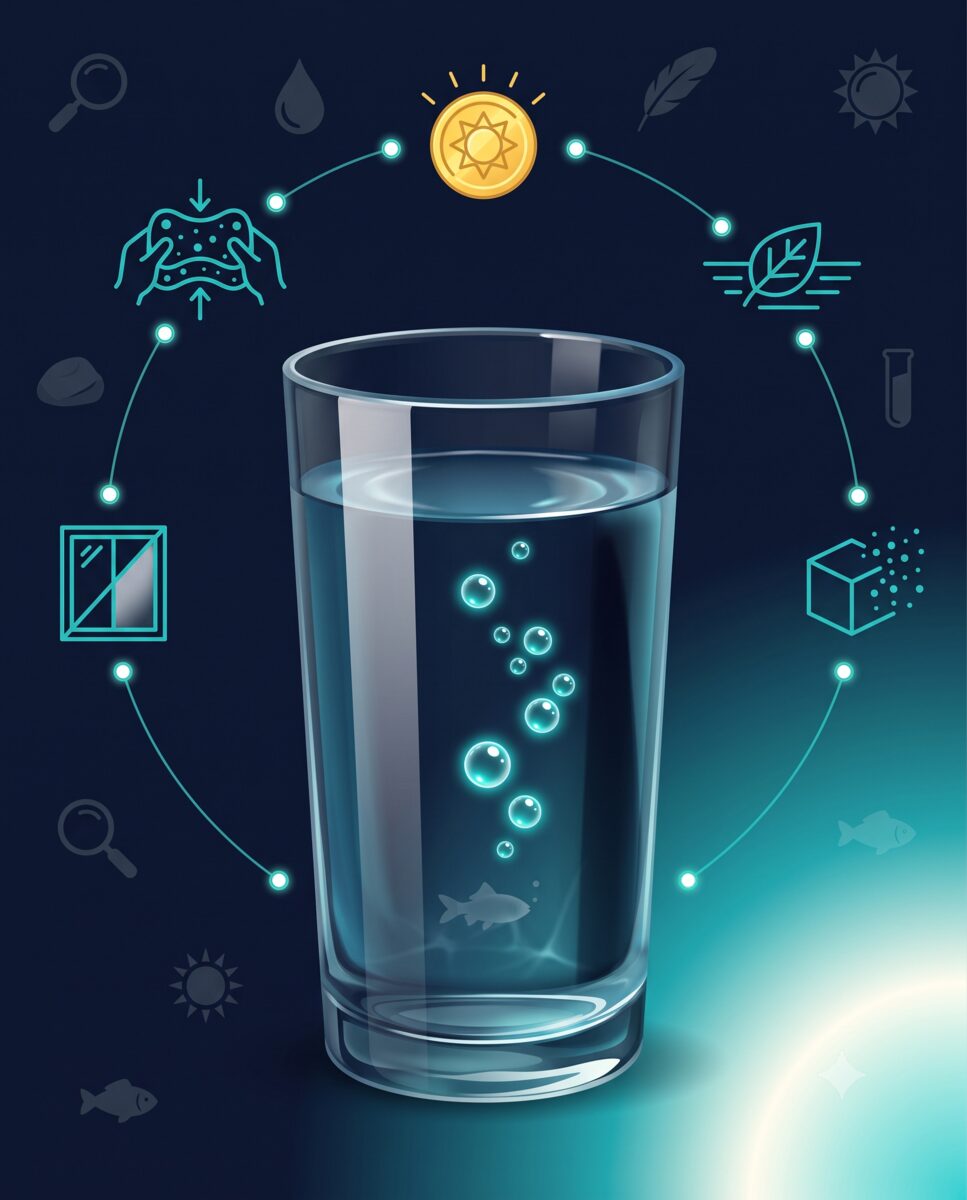
Hero image — save as hero_image.png in this folder
🔑Key Terms to Know
Lustre
The shiny, reflective appearance seen mainly in metals.
Soluble
Disappears and mixes evenly with water.
Insoluble
Does not mix with water; settles or floats instead.
Miscible
Liquids that mix completely with each other.
Immiscible
Liquids that separate into distinct layers.
Transparent
Allows clear vision through it.
Translucent
Allows light through but blurs the view.
Opaque
Blocks all light; forms dark shadows.
Quick Recall — Sprint Facts
LustrousGold, silver, copper, fresh iron
Soluble SolidsSalt, sugar, baking soda
Insoluble SolidsSand, chalk powder, sawdust
Miscible LiquidsVinegar, lemon juice, milk
Immiscible LiquidsMustard oil, kerosene, petrol
TransparentClear glass, clean water, air
TranslucentButter paper, frosted glass, muslin
OpaqueWood, brick, metal, cardboard
🏆Olympiad & Challenger Edge
Density & Buoyancy
Floating and sinking are really about density (ρ = m/V). If an object's density is greater than the fluid's, it sinks; if lower, it floats. The upward push from the fluid is called buoyant force.
Solubility & Temperature
Hot water dissolves more sugar (solids dissolve better when warm), but holds less oxygen (gases dissolve better when cold) — this is why warm river water from factories can suffocate fish.
Refractory Materials
Furnaces are lined with silica or fireclay refractories that withstand temperatures up to 1650°C without melting — ordinary metals would melt or warp.
Thermal Shock Resistance
Lab glassware is made of borosilicate glass because its low thermal expansion stops it cracking under sudden temperature change — a property called thermal shock resistance.
Sponge is a solid, not a gas
Compressing a sponge just expels trapped air — it never stops being a solid.
Insoluble vs. Immiscible
Use "insoluble" only for solids (sand); use "immiscible" only for liquids (oil).
Translucent needs both parts
Write "light passes through, but objects cannot be seen clearly" — not just "light passes through."
Name the exact liquid or solid
Write "pure water" or "clear glass," not just "water" or "glass" — muddy water is opaque.
Transparent Sweet Jars
Shopkeepers store candy in clear glass or plastic jars so buyers can see them without opening lids.
Cookware Design
Pan bases are metal (good heat conductor); handles are wood or plastic (insulators) so hands don't burn.
Waste Disposal Safety
Broken glass goes into thick, opaque, puncture-resistant bins — never thin paper bags.
Fish Breathing Underwater
Dissolved oxygen in water lets fish extract it through their gills to survive.
Melting ≠ Dissolving
Ice melts into water due to heat (a state change); salt dissolves in water to form a solution — don't confuse the two.
The Sponge Trap
A sponge is soft because of trapped air pockets — it stays a solid even when squeezed flat.
Dull Metal Confusion
A dull iron nail isn't a non-metal — rust from air and moisture hides the true lustre underneath.
Sand Doesn't Dissolve
Sand settling in water is not "dissolving" — it stays insoluble and simply sinks.
Logic Chain — How We Sort Materials Into Useful Groups
Step 1
Observing an object's properties (shine, hardness, solubility, transparency) connects to identifying which category it belongs in.
Step 2
Identifying the category connects to sorting the material into a distinct group (soluble/insoluble, transparent/opaque, and so on).
Step 3
Sorting into groups connects to comparing materials fairly, since similar materials can now be studied side by side.
Step 4
Comparing materials connects to choosing the right one for a purpose — like glass for a tumbler instead of porous cloth.
🦉
Mentor Byte
Every material carries a quiet reason for being chosen — glass lets you see, wood keeps its shape, metal carries heat. Learn to ask "why this material, not another?" and the whole chapter stops being a list and becomes a way of seeing the made world around you.
For Parents
At home, ask your child why a water bottle is plastic and not cloth, or why a spoon is metal and not paper — this turns memorisation into everyday observation.