Class 7 | SST
Chapter 11 | From Barter to Money
Aligned with CBSE | NCERT | School & Olympiad Standards
Focus on What Matters Most
The67Sprint
🔄 The Barter System
- Barter is the direct exchange of goods and services for other goods and services, without using money
- Double Coincidence of Wants: both parties must want exactly what the other person has, at the same time
- Divisibility: a live ox cannot be split into small pieces to buy a pair of shoes
- Portability: carrying bulky goods like cattle or sacks of wheat over long distances is exhausting
- Durability: wealth stored as grain or crops rots or gets eaten by pests before it can be used
💰 Functions of Money
- Medium of Exchange: universally accepted, so it removes the need for a double coincidence of wants
- Common Measure of Value: gives every good a fixed price, so goods can be compared easily
- Store of Value: can be saved securely for future use, unlike wheat or vegetables that spoil
- Standard of Deferred Payment: lets a buyer take a good today and pay later, if the seller trusts them
Trust = Credit
🏦 Who Issues Currency
- The Reserve Bank of India (RBI) is the sole legal authority that issues paper currency in India
- Paper money was first used in China, long before it reached India in the late 18th century
- Early metal coins — alloys of silver and copper — were called kārṣhāpaṇas or paṇas, punched with royal symbols called rūpas
Memory Cheat Code
D.D.C.P. = Divisibility, Durability, Coincidence of wants, Portability — the four fatal flaws of barter.
Quick Recall — Sprint Facts
Early Money
Cowrie shells, salt, and cattle were used before coins existed
Roman Gold Coins
Found in Pudukkottai, Tamil Nadu — proof of maritime trade with Rome
Junbeel Mela
Assam fair where tribal communities still barter hill produce for plains goods
60 vs 100 Paṇas
Arthaśhāstra: a year's salary was 60 paṇas; the fine for refusing a neighbour help was 100
RBI Security
Watermarks, security threads, micro-lettering, and tactile marks stop fake notes
QR & UPI
A QR code holds bank details — it transfers intangible digital money, it isn't money itself
🔑 Key Terms
Barter System
Exchanging goods or services directly, without using money
Double Coincidence of Wants
Both parties happen to want exactly what the other one has to offer
Medium of Exchange
Money's core function — universally accepted, replacing the need for direct barter
Minting
The process of manufacturing coins, historically controlled by rulers or governments
Alloy
A metal made by combining two or more metals, e.g. silver and copper, for stronger coins
QR Code
Black-and-white squares holding digital bank details, used to transfer money via UPI
Olympiad & Challenger Edge
Favourable Balance of Trade
Roman gold coins found in South India show Rome paid in precious metal because it imported far more spices and textiles from India than it exported back — wealth flowed into India.
Law Enforcing Social Duty
Kautilya's Arthaśhāstra fined 100 paṇas for refusing to help a neighbour, against a 60 paṇas annual salary — ancient statecraft valued community welfare over individual wealth.
Why Modern Barter Survives
Swapping old clothes for utensils or books for books still happens today because it encourages reuse, reduces waste, and builds a sense of community.
Intangible Capital Shift
Money moved from intrinsic value (gold, cattle) to fiat paper backed by the RBI, to intangible UPI ledgers — each stage relies on deeper public trust in institutions.
❌ Store of Value = Deferred Payment?
Not the same. Store of Value means saving money safely for the future. Deferred Payment means buying now and promising to pay later.
❌ Barter is extinct?
No. It survives today — the Junbeel Mela in Assam, and swapping old clothes for utensils or books for books.
❌ Any bank can print notes?
Wrong. Only the Reserve Bank of India (RBI) has the legal authority to issue paper currency in India.
❌ Naming UPI or RBI without expanding?
Always write the full form: Unified Payments Interface, and Reserve Bank of India — full marks need both.
🥪 Lunchbox Barter
Swapping your sandwich for a friend's juice box is the barter system in action — right there in the school yard.
📖 Waiting to Pay Later
A shopkeeper who lets you take a book today and pay next week is trusting you — money working as deferred payment.
🔍 Spotting Fake Notes
Tilt a ₹500 note to see the ink change colour, or feel the raised tactile marks — RBI's anti-counterfeiting tricks.
📱 Scanning to Pay
When a fruit vendor scans a QR code, no coins change hands — bank details are read and money moves electronically.
🚨 Incomplete Divisibility Answer
Don't just name "Divisibility" — explain it: a farmer cannot cut a live ox into pieces to buy a small pair of shoes.
🚨 Wrong Currency Issuer
Writing "the government" or "State Bank of India" prints notes is incorrect — it must be the RBI, by name.
🚨 Missing Roman Trade Context
If asked about the Pudukkottai coins, you must state they prove favourable maritime trade with the Roman Empire.
🚨 QR Code Confusion
A QR code is not money — it's a reader for digital bank details that lets UPI transfer intangible money.
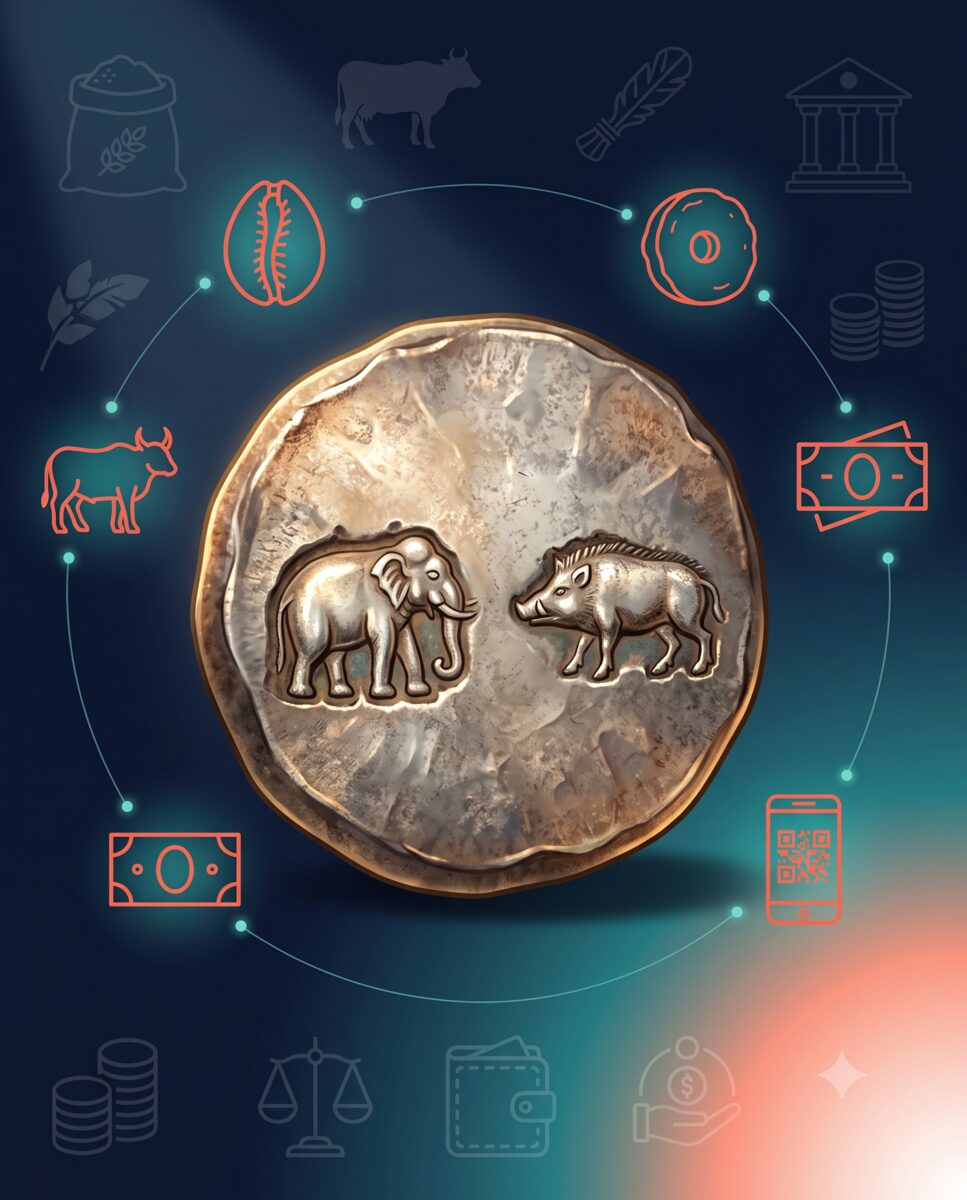
Logic Chain — How Barter Became Digital Money
Step 1
Barter's flaws — no double coincidence of wants, and goods that can't be divided, carried, or stored — connect directly to the need for a better system
Step 2
That need leads to commodity money and then metal coins — alloyed kārṣhāpaṇas, punched with royal rūpas to guarantee their value
Step 3
Heavy metal coins connect to the invention of lightweight paper currency, issued and secured by the Reserve Bank of India
Step 4
Paper currency leads to intangible digital money — UPI and QR codes — moving bank ledgers instantly, without any physical exchange
🦉
Mentor Byte
"Money is a bridge between the present and the future. Picture yourself as a farmer trying to trade a live ox for a pair of shoes — you cannot split the ox, and the shoe-seller may not even want an ox. Feel that frustration, and every later invention — coins, paper notes, UPI — starts to look like a small miracle solving one very old, very human problem: trust between strangers."
💛 Parent Tip
Next time you scan a QR code together at a shop, pause and ask your child what actually moved — not coins, but a message to the bank. This one question turns an abstract idea into something they've watched happen with their own eyes.