Class 6 | SST
Chapter 14 | Economic Activities Around Us
Aligned with CBSE | NCERT | School & Olympiad Standards
Focus on What Matters Most
The67Sprint
Economic vs. Non-Economic
- Economic activities create monetary value or are done in exchange for money (a carpenter making furniture, a tailor stitching clothes).
- Non-economic activities are driven by love, care, duty, or Sevā and generate no income, but hold deep social value (cooking for family, community clean-ups).
The Three Sectors
- Primary: extracting or harvesting directly from nature — farming, mining, fishing, forestry, livestock.
- Secondary: transforming raw materials into finished goods or building infrastructure — factories, weaving, construction.
- Tertiary: providing services that support the other sectors — transport, banking, retail, healthcare.
Sector Interdependence
- No sector works alone — a textbook needs trees cut (Primary), paper made and printed (Secondary), then transported and sold (Tertiary).
AMUL & Cooperatives
- A cooperative is a group who voluntarily join to manage a business and share profits democratically.
- AMUL was set up in Gujarat in 1946 by Tribhuvandas Patel and Dr. Verghese Kurien, ending exploitative middlemen in the dairy trade.
Resource Conservation
- Used paper can be recycled to make new paper — a Secondary sector activity that drastically cuts the need to extract fresh wood from the Primary sector.
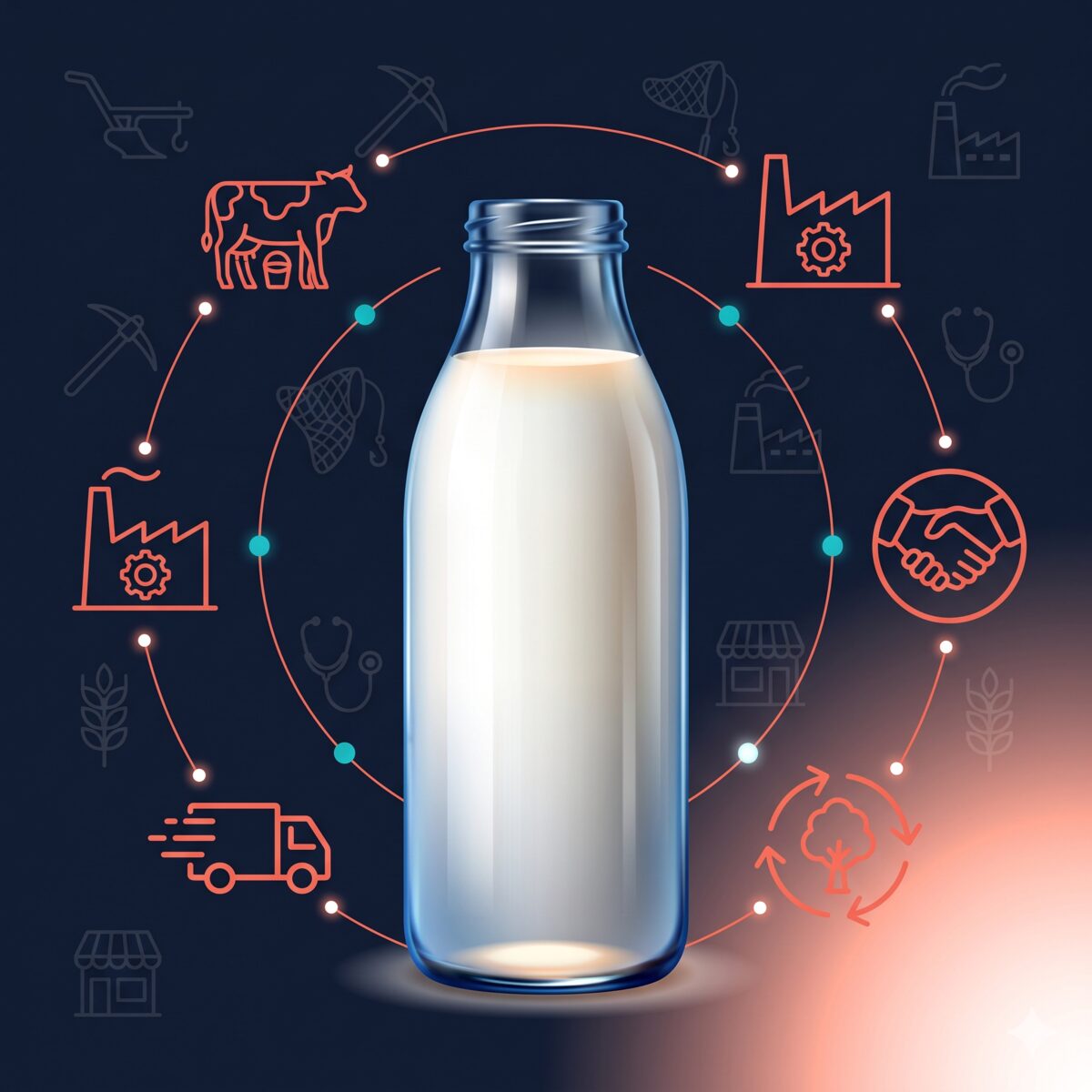
Hero image pending — link placeholder active
Quick Recall — Sprint Facts
1946
Year AMUL was founded in Anand, Gujarat
2 Crore
Two-wheelers produced in India in 2022
45 Lakh
Passenger cars produced in India in 2022
Sardar Patel
Advised the Anand farmers to form a cooperative
🔑 Key Terms to Know
Monetary Value
The value of something measured in terms of money.
Middlemen
Traders who buy from producers cheap and sell to consumers at a markup.
Pasteurisation
Heating milk to a set temperature then cooling it quickly to kill bacteria.
Retail
Selling goods in small quantities directly to the end consumer.
Warehouse
A large building used to store goods safely before sale or distribution.
Export
Goods or services produced in one country and sold to buyers in another.
🏆 Olympiad & Challenger Edge
Quantitative Conservation
Recycling 1 tonne of paper saves 17 mature trees and 2.5 cubic metres of landfill space, and uses 70% less energy and water than making new paper.
Value Chain Economics
The lowest economic value sits at raw extraction (milking a cow); the maximum market value is added by the time a product reaches Tertiary retail.
Waged vs. Salaried
A daily-wage laborer is informally paid per task, while a salaried manager is formally paid monthly — even within the same sector.
Institutional Solutions
AMUL vertically integrated farming, processing, and retail into one farmer-owned unit, bypassing exploitative middlemen entirely.
The Cargo Trap
A truck carrying wheat or logs is still Tertiary — transporting anything is a service, regardless of the cargo.
Construction Confusion
Building roads or pipelines is Secondary, not Tertiary — it involves processing materials into infrastructure.
Missing Units
Always write "per 1 tonne of paper" when quoting recycling stats — leaving out the unit costs marks.
Incomplete Definitions
Don't just say the secondary sector "makes things" — specify it transforms raw materials from the primary sector into finished goods.
Tech & Gaming
A software developer coding a game provides a Tertiary service; the factory assembling your console is Secondary.
Home Cooking vs. Restaurant
A parent cooking dinner out of love is Non-Economic; the same meal bought from a chef is Tertiary.
Community Clean-ups
Swachh Bharat Abhiyan and Van Mahotsav tree-plantation drives are valuable Non-Economic community service.
Food Delivery Chain
Growing potatoes is Primary; a cloud kitchen frying chips is Secondary; the delivery partner and app are Tertiary.
Devaluing Non-Economic Work
Non-economic activities lack monetary value, but hold deep social value — they sustain the workforce and community.
Retail vs. Warehousing
Warehousing stores goods before sale; retail is the final sale of small quantities directly to the consumer — don't mix them up.
Diagram Labeling
When drawing sector-interdependence flowcharts, always use directional arrows to show the flow between sectors.
Mining vs. Processing
Milking a cow is Primary extraction; turning that milk into butter or cheese is a separate Secondary step — don't merge them.
Logic Chain — How a Textbook Reaches a Student
Step 1
Trees are grown and cut in a forest (Primary) — this raw wood connects to the next stage as the input a paper mill needs.
Step 2
Logs are transported by truck to the mill (Tertiary) — this service connects the forest's raw material to industrial processing.
Step 3
Logs are pulped into paper and printed into books (Secondary) — this manufacturing step connects raw wood to a finished product.
Step 4
Printed books are shipped to bookstores and sold (Tertiary) — this distribution step connects the finished product to the student who needs it.
🦉
Mentor Byte
Stop memorizing lists of jobs — ask one question instead: does this job extract, make, or serve? Pull something from the earth, and it's Primary. Build or process something new, and it's Secondary. Move, sell, or care for someone, and it's Tertiary. Master this lens, and no exam can trick you on sector classification again.
For Parents
Ask your child to trace their breakfast backward through all three sectors — it turns an abstract concept into a game they can play at the table.