Class 6 | English
Chapter 13 | Hamara Bharat — Incredible India!
Aligned with CBSE | NCERT | School & Olympiad Standards
Focus on What Matters Most
The67Sprint
📚 Overview & Heritage
- Chapter 13, "Hamara Bharat — Incredible India!", Unit 5 (Culture and Tradition), NCERT Class 6 English, Poorvi
- Bharat is known worldwide as a land of wise and heroic people, with rivers, lakes, mountains and forests rich in wildlife
- Every citizen shares the duty to work hard so the country keeps growing and earning respect
🤝 Ek Bharat, Shreshtha Bharat
- A Government of India programme to celebrate unity in diversity and strengthen emotional bonds among citizens
- It pairs states and Union Territories (state/UT pairing)
- Pairing builds interaction, mutual understanding and sharing of best practices in languages, handicrafts, literature and art
🎨 Aipan — Uttarakhand (Akanksha)
- Folk art drawn by women at family functions and festivals
- White rice flour paste is drawn over brick-red surfaces coloured with geru (red clay)
- Drawn on floors, walls of puja rooms and main entrances
- Mathematical designs inspired by nature and tradition
🔥 Dhokra — Odisha (Priyaranjan)
- Non-ferrous metal casting art over 4,000 years old
- Lost-wax technique with clay, wax, brass scrap and fire
- Melted brass scrap is poured into the hollow space left when the wax melts and drains out of small openings
🥥 Coconut Shell Craft — Kerala (Chitra)
- An eco-friendly, biodegradable craft
- The outer shells are smoothed with sandpaper or machines, given a base for stability and finished with wood polish
- Made into bowls, lamps and jewellery
🧸 Kondapalli Toys — Andhra Pradesh (Balamurali)
- About 400 years old; made of soft wood from nearby hills
- Parts are carved separately and joined with makku, a paste of tamarind seed powder and sawdust
- Finished with vegetable dyes, watercolours or enamel; they show folk tales and village life
🍲 Gakkad Bharta — Jabalpur, MP (Sushil)
- An unfried dish: wheat dough balls (gakkad) roasted at high heat
- Roasted brinjals and tomatoes make the bharta
- Served crumbled, with ghee
✍️ Grammar — Simple Present Tense
- Used for routines, facts and descriptions
- Singular subjects (he, she, it, Akanksha) take -s/-es: He runs
- Plural subjects (I, you, we, they) keep the base verb: The birds sing
He runs
They sing
🔢 Process Words
- Sequence words show the order of steps in a description
- First, to begin, then, after that, next, finally, at last
Central Idea
Unity in diversity. Each state's crafts and food are part of one shared, incredible Bharat.
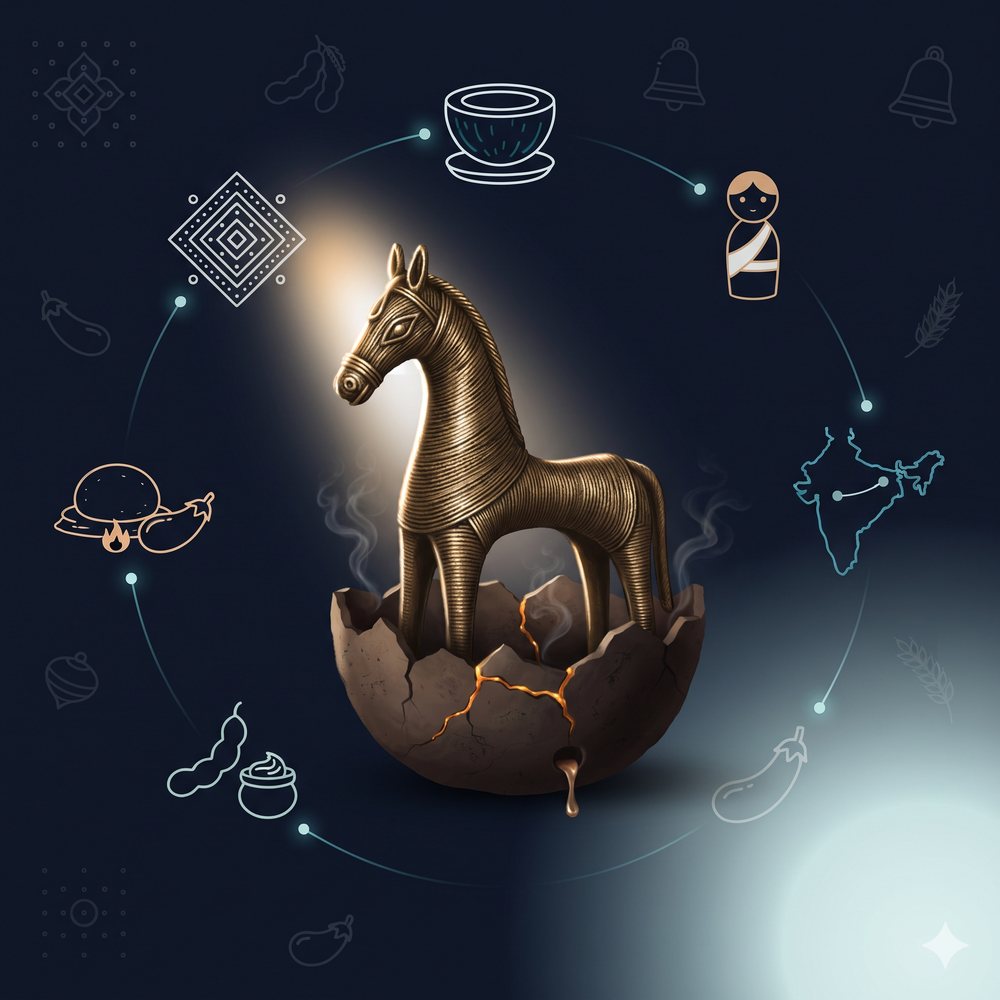
Quick Recall — Sprint Facts
Textbook & Unit
Poorvi Class 6, Unit 5 (Culture and Tradition), Chapter 13
National Programme
Ek Bharat, Shreshtha Bharat — state/UT pairing
Uttarakhand
Aipan • Akanksha • geru (red clay) + white rice paste
Odisha
Dhokra • Priyaranjan • 4,000-year-old lost-wax art with brass scrap
Kerala
Coconut Shell Craft • Chitra • sandpaper + base + wood polish
Andhra Pradesh
Kondapalli Toys • Balamurali • soft wood + makku + vegetable dyes
Jabalpur, MP
Gakkad Bharta • Sushil • roasted wheat dough + roasted brinjal/tomato + ghee
Makku
Tamarind seed powder + sawdust
Geru
Brick-red natural clay for the background of Aipan
Dhokra Process
Clay model → wax → clay coat → heat (wax drains) → pour brass → break the mold
Coconut Craft Is
Biodegradable and eco-friendly
Grammar: Singular
He / She / It + verb with -s/-es
Grammar: Plural
I / You / We / They + base verb
Process Words
First → Then → After that → Next → At last
🔑 Key Terms
Unity in Diversity
People of different languages, cultures, religions and regions living in harmony in one nation
Ek Bharat, Shreshtha Bharat
A national programme that pairs states and UTs to share culture and build understanding
State Pairing
The way the programme works: two states/UTs are paired to exchange culture
Geru
Brick-red natural clay used to coat walls and floors as a background for traditional art
Makku
A natural sticky paste of tamarind seed powder and sawdust that joins wooden toy parts
Biodegradable
Able to break down naturally without harming the environment, as coconut shells and wood do
Lost-Wax Technique
A casting method: a wax model in clay is heated, the wax drains out, and molten metal fills the hollow
Process Words
Connectors like first, after that, next, then and at last that show the order of steps
🏆 Olympiad & Challenger Edge
Circular Economy in Crafts
Traditional crafts reuse agricultural by-products: coconut shells for bowls and lamps, tamarind seed powder for adhesive. Compared with synthetic manufacturing, they can generate far less waste.
Dhokra and Modern Casting
The 4,000-year-old lost-wax process (cire perdue) can be compared with modern precision casting, showing the engineering continuity of tribal artisans.
Process Words as Discourse Markers
Connectors keep a text cohesive and logically clear in informative writing, so a reader can follow each step.
Maths Hidden in Aipan
Aipan's mathematical, nature-inspired patterns show geometry in everyday folk art.
Pairing Builds Unity
State/UT pairing lets students interact, share regional art forms, build emotional bonds and find a shared identity, which is how it turns "unity in diversity" into action.
Choosing Crafts by Property
Match craft to need: a biodegradable, stable household item points to coconut shell craft; a natural adhesive for joining wood points to Kondapalli toys.
❌ Wrong State–Art Pairing
Pair strictly: Akanksha → Uttarakhand → Aipan; Priyaranjan → Odisha → Dhokra; Chitra → Kerala → Coconut Shell Craft; Balamurali → Andhra Pradesh → Kondapalli Toys.
❌ Makku Is Synthetic Glue?
Wrong. Makku is a natural paste of tamarind seed powder and sawdust.
❌ Geru Is White?
Wrong. Aipan uses white rice flour paste on a brick-red geru background.
❌ Dhokra Is an Iron Craft?
Wrong. Dhokra is a non-ferrous metal craft that uses melted brass scrap. It is over 4,000 years old.
✍️ Aipan: Who, Where, What
Made by women at festivals and family functions, on floors, puja-room walls and entrances, in white rice paste over geru, with mathematical nature-inspired designs.
✍️ Kondapalli Details
Soft wood from nearby hills; parts carved separately; joined with makku; painted with vegetable dyes, watercolours or enamel; about 400 years old.
✍️ Coconut Craft Steps
Smooth the shell with sandpaper or machines, fit a base for stability, then apply wood polish.
✍️ Subject–Verb Agreement
Write "The birds sing" and "He runs", not "The birds sings" or "He run". Circle the subject before choosing the verb.
✍️ Use Sequence Markers
Start procedure steps with First, To begin, Then, After that, Next, Finally or At last.
✍️ Dhokra Step Order
Clay model, wax and carving, clay coat with openings, heat to drain the wax, pour brass, remove the clay.
🏫 School Cultural Exchange
Run Ek Bharat, Shreshtha Bharat days where paired groups present the art, food and folk stories of partner states.
♻️ Eco-Friendly Living
Coconut shell bowls, lamps and wooden toys are biodegradable alternatives to plastic decor.
🪔 Festival Floor Art
Draw geometric, nature-inspired Aipan or rangoli patterns at the entrance with rice paste and natural red clay.
🥗 Oil-Free Cooking
Roasting, as in Jabalpur's Gakkad Bharta, is a healthy non-fried way of cooking.
🔠 Regional Spellings
Spell geru, makku, Dhokra and Aipan exactly.
📖 Define the Programme
Don't say Ek Bharat, Shreshtha Bharat is only a school programme. Mention state pairing, unity in diversity and national integration.
📋 Tables Need All Materials
Include every raw material, e.g. white rice flour paste for Aipan and tamarind seed powder for Kondapalli toys.
🕰️ Tense Consistency
Don't mix past and simple present when describing a process or habits.
🔢 Numbers to Recall
Dhokra: over 4,000 years. Kondapalli toys: about 400 years.
🍲 Gakkad Bharta Facts
The dish is unfried: roasted wheat dough balls with roasted brinjal and tomato, served with ghee. It is from Jabalpur, MP (Sushil).
Logic Chain — How Lost Wax Becomes a Brass Figure
Step 1 — Model
A clay figure is made and dried, which leads to a layer of wax being added and carved with fine details
Step 2 — Cover
The clay-covered wax model, with small openings, goes into the fire, which leads the wax to melt and drain out
Step 3 — Pour
The drained wax leaves a hollow space, which leads to molten brass scrap being poured into it
Step 4 — Finish
Once the brass cools, the outer clay layer is removed, which leads to the finished Dhokra figure
🦉
Mentor Byte
"Precision in facts and grammar secures top marks. Draw a four-column Handicraft Summary Table in your notebook: State | Artisan | Art Form | Raw Materials and Process. When answering procedural questions, use sequence markers (First, Next, Then, At last). For grammar, circle the subject before choosing the verb: if it is singular (he, she, it, Akanksha), add -s or -es. This habit removes the most common errors."
For Parents
Ask your child to explain one craft to you step by step using First, Then, After that and At last. Then ask which state it comes from and which natural material it uses.