Class 6 | Science
Chapter 9 | Methods of Separation in Everyday Life
Aligned with CBSE | NCERT | School & Olympiad Standards
Focus on What Matters Most
The67Sprint
Handpicking
- Picking impurities by hand — used when the quantity of impurities is small and differs in size, colour, or shape (e.g. stones from rice).
Threshing
- Beating harvested stalks on a wooden log to free the grain seeds from the stalk.
Winnowing
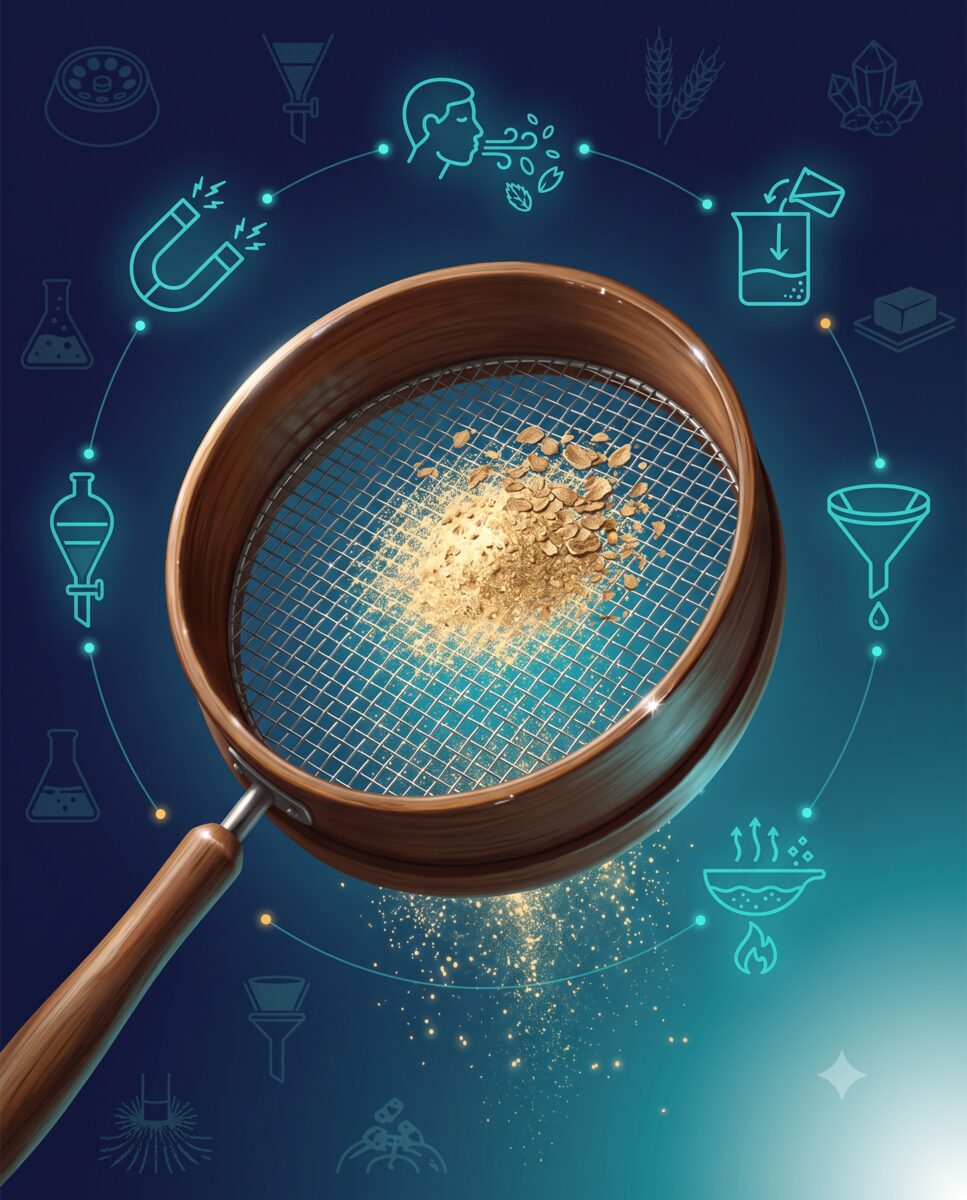
- Separating heavier and lighter components (grain and husk) by wind or blowing air — often using a bamboo tray (soop).
Sieving
- A porous mesh lets fine particles pass through while retaining larger ones — requires a difference in particle size (e.g. bran from flour).
Sedimentation & Decantation
- Sedimentation: heavier insoluble particles settle at the bottom. Decantation: pouring off the clear liquid without disturbing the sediment.
Filtration
- Passing a mixture through a porous filter (muslin cloth/filter paper) to trap insoluble solids. Solid trapped = residue; liquid that passes = filtrate.
Evaporation
- Converting a liquid into vapour by heating — used to recover dissolved solids, like salt from seawater trapped in shallow pits.
Condensation
- Cooling water vapour back into liquid water — e.g. droplets forming on the outside of a cold water bottle.
Churning
- Continuously beating a liquid (curd) with a mathni so lighter fat (butter) separates and floats above the buttermilk.
Solubility Fact
A saturated solution can dissolve no more solute at that temperature — heating a solution generally lets it dissolve more solute.
Quick Recall — Sprint Facts
Harvest OrderThreshing → Winnowing → Sieving
Salt from SeaShallow pits + sun = evaporation
Oil & WaterImmiscible — separated by decantation
Butter TrickChurning curd makes butter float up
🔑 Key Terms to Know
Mixture
Two or more substances combined physically, each retaining its own properties.
Filtrate
The clear liquid that passes through a filter.
Residue
The solid, insoluble particles trapped and left behind on the filter.
Saturated Solution
A solution that cannot dissolve any more solute at that temperature.
🏆 Olympiad & Challenger Edge
Magnetic Separation
Using a magnet to attract and remove magnetic materials (like iron filings) from non-magnetic mixtures — a common NSO/Olympiad extension of physical-property separation.
Centrifugation
The advanced, high-speed version of churning — spins a mixture rapidly so heavier particles move outward and lighter ones stay near the centre.
Loading (Coagulation)
Adding a chemical like alum to fine suspended clay particles in muddy water, making them heavier so they settle faster.
Sublimation
Some solids (like camphor or iodine) turn directly into gas on heating — used to separate them from non-sublimable impurities.
Threshing vs Winnowing
Threshing is beating stalks to free the seeds. Winnowing is dropping the mixture in the wind to blow husk away. Never interchange them.
Filtration Cannot Catch Dissolved Solids
Dissolved salt or sugar passes right through a filter. Use evaporation for dissolved solids, not filtration.
Complete the Winnowing Definition
Always write "separating heavier and lighter components of a mixture by wind or blowing air" — dropping "wind" costs marks.
Sequencing Multi-Step Separation
Filter before you evaporate — evaporating first traps sand inside your recovered salt.
Morning Tea
Pouring boiled tea through a strainer is filtration — the leaves are trapped, the liquid tea passes through.
Making Paneer
Adding lemon to hot milk and straining through muslin cloth separates solid paneer from liquid whey — filtration in the kitchen.
Salt Pans by the Sea
Shallow pits trap seawater; the sun evaporates the water over days, leaving behind common salt.
Drying Clothes After Sport
Wet clothes dry because heat turns the liquid sweat/water into vapour — everyday evaporation at work.
Incomplete Winnowing Definition
Leaving out "by wind or blowing air" is an automatic mark deduction.
Wrong Order in Multi-Step Separation
Evaporating before filtering ruins the process — insoluble solids must be removed first.
Missing Diagram Labels
Decantation diagrams must clearly label "sediment" and "clear liquid" — unlabelled diagrams lose marks.
Confusing Filtrate and Residue
Filtrate is the liquid that passes through; residue is the solid left behind. Mixing these up is a common error.
Logic Chain — How a Mixed-Up Sample Becomes Pure Salt
Step 1
Magnetic separation removes iron filings, which connects to a mixture of only sand, salt, and water remaining.
Step 2
Filtration traps the sand as residue, which leads to clear salt water passing through as the filtrate.
Step 3
Evaporation turns the water in the filtrate to vapour, which connects to pure solid salt being left behind.
Step 4
Condensation cools the collected water vapour back to liquid, which leads to pure water being recovered as well.
🦉
Mentor Byte
Always ask "what is the physical difference between these two substances?" before naming a method. If a student says "sieving separates flour and bran," push further — sieving works because of a difference in particle size. That shift, from naming a method to identifying the property behind it, turns memorisation into reasoning.
For Parents
At home, ask your child to name the separation method the next time you strain tea, make paneer, or churn curd — everyday kitchen moments are the easiest way to reinforce this chapter.