Class 6 | Science
Chapter 11 | Nature's Treasures
Aligned with CBSE | NCERT | School & Olympiad Standards
Focus on What Matters Most
The67Sprint
Natural & Human-Made Resources
- Natural Resources: materials provided directly by nature essential for survival — air, water, sunlight, forests, soil, rocks, minerals, fossil fuels.
- Human-Made Resources: objects created by processing natural resources — tools, machines, vehicles, buildings.
- Example: plastic in a geometry box comes from petroleum; steel in a bicycle comes from iron ore.
Renewable vs Non-Renewable
- Renewable: replenished by natural processes within a reasonable time — sunlight, wind, water, forests.
- Non-Renewable: exist in limited quantities, take millions of years to form — coal, petroleum, natural gas, minerals.
- Natural does not mean renewable — fossil fuels are 100% natural but non-renewable.
Air & Energy from the Sun
- Air is a mixture: 78% Nitrogen, 21% Oxygen, remaining 1% is carbon dioxide, water vapour, dust and smoke.
- The Sun is the ultimate source of energy for all living things on Earth.
- Moving air (wind) spins a paper firki and powers windmill farms in Tamil Nadu and Rajasthan.
Forests, Soil, Rocks & Minerals
- Forests act as Earth's "green lungs" — prevent soil erosion, regulate water flow, support biodiversity.
- Soil forms from the breakdown of rocks and is enriched by decaying matter and earthworms.
- Rocks provide building materials; minerals are sourced from rocks to make metals.
- Jhum farming (North-East India): weeds/bamboo are cut and burned so ash naturally fertilises the soil, instead of ploughing.
Water Conservation
Most of Earth's water is saline ocean water — freshwater is limited and precious. Traditional stepwells like Bawadi (Rajasthan) and Vav (Gujarat) harvest rainwater and recharge groundwater.
🔑 Key Terms to Know
Rainwater Harvesting
Collecting and storing rainwater from rooftops for future use and groundwater recharge.
Fossil Fuels
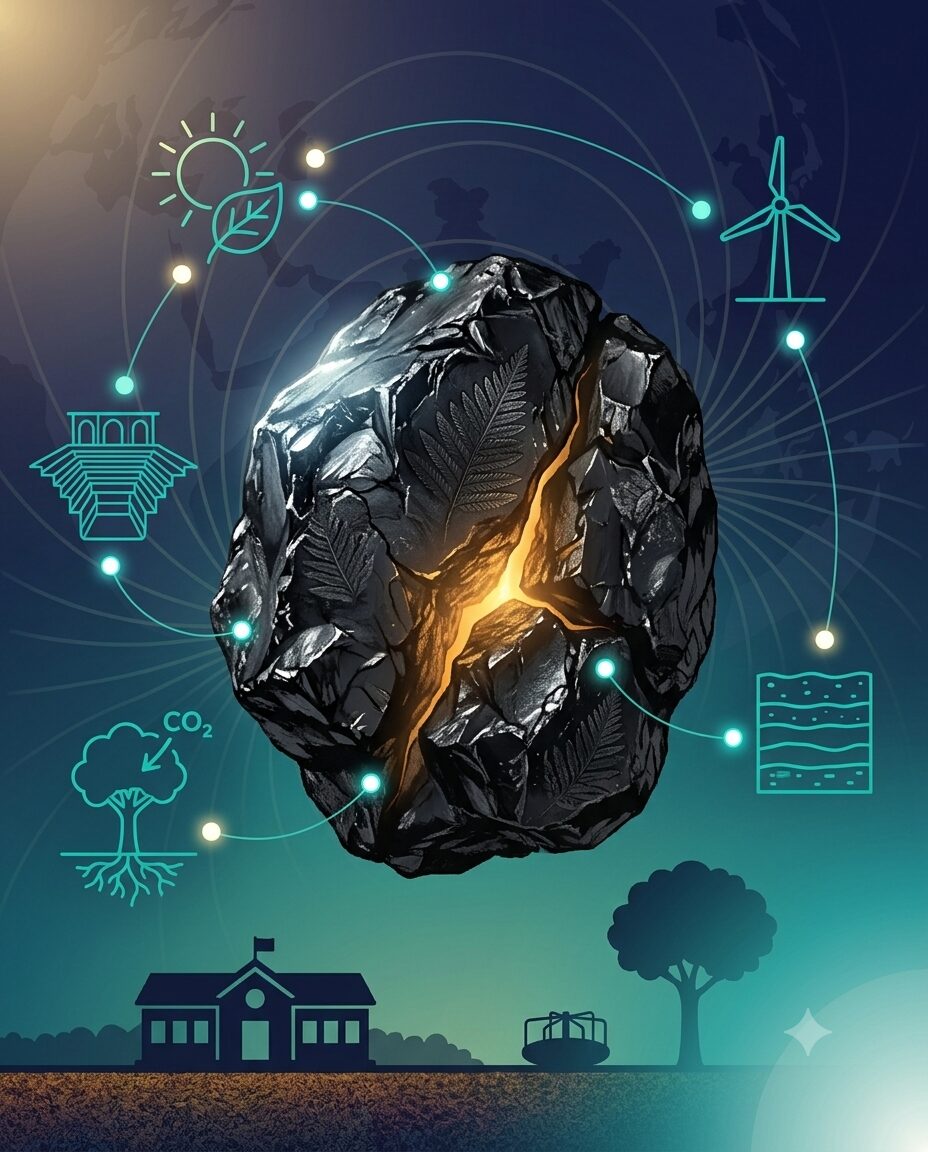
Coal, petroleum and natural gas formed from dead remains of organisms under heat and pressure over millions of years.
Deforestation
Large-scale cutting of trees, causing habitat loss, climate change and soil erosion.
Jhum Farming
Traditional North-East Indian practice of cutting and burning weeds so ash fertilises the soil, without ploughing.
🔁 Quick Recall — Sprint Facts
78% N₂ / 21% O₂
Sun = ultimate energy source
Chipko Movement
Earthworms = friends of farmers
Van Mahotsav
🏆 Olympiad & Challenger Edge
Beyond Solar & Wind
Geothermal, tidal, bio-fuel and hydrogen energy are non-conventional energy vectors.
Condensation Nuclei
Dust and smoke particles in air are prerequisites for cloud formation and precipitation.
Photosynthesis Equation
6CO₂ + 6H₂O + Light Energy → (Chlorophyll) → C₆H₁₂O₆ + 6O₂.
Residual vs Transported Soil
Residual soil stays above its parent bedrock; transported soil is carried by wind (aeolian) or water (alluvial).
Fossil Fuels Need Full Definition
Don't just say "fuels from the earth" — state they form from dead remains of organisms under heat and pressure over millions of years.
Name the 3Rs Specifically
"Save water" is too vague. Write actionable steps: fix leaking taps, use sensor push-taps, use a bucket instead of a hosepipe.
Air Composition, Exactly
78% Nitrogen, 21% Oxygen, remaining 1% carbon dioxide, water vapour, dust and smoke — not "mostly oxygen."
Natural ≠ Renewable
Always state the timeline: coal and petroleum are natural but take millions of years to form, so they're non-renewable.
Solar Cookers
Cooking with sunlight instead of electricity or firewood — clean energy, but depends on sunny weather.
Greywater Reuse
Leftover water from washing vegetables or bathing waters household gardens, saving freshwater.
Active Commuting
Walking, cycling or carpooling for short trips cuts fossil fuel combustion directly.
Rooftop Solar Panels
Homes generating electricity from sunlight instead of burning coal.
Fossil Fuels ≠ Renewable
Being natural doesn't mean renewable — coal and petroleum take millions of years to form.
Air Isn't Pure Oxygen
Nitrogen (78%) dominates, not oxygen (21%) — a common reversal error.
Machines Aren't Natural
Tools and vehicles are human-made resources, even though they're built from natural materials like metal ores.
Don't Skip the 3Rs
Questions on waste/resource management expect Reduce, Reuse, Recycle explicitly — not general statements.
🔗 Logic Chain — How Fossil Fuels Form
Step 1
Plants and microorganisms die and connect to layers of sediment as they get buried deep inside the earth.
Step 2
Burial under sediment connects to extreme heat and pressure building up over millions of years.
Step 3
Millions of years of heat and pressure connect to a complete chemical transformation of the buried matter.
Step 4
That transformation leads to non-renewable coal, petroleum and natural gas — resources we cannot quickly replace.
🦉
Mentor Byte
Think of Earth's resources like a bank account. Renewable resources are your monthly income — sunlight and wind arrive again and again, ready to use. Non-renewable resources are fixed savings built up over millions of years — coal and petroleum. Spend the fixed savings carelessly, and no deposit will refill them in your lifetime. A wise custodian lives off the income and protects the savings.
For Parents
Ask your child to trace one object at home — a pencil, a plastic toy, a metal spoon — back to the natural resource it came from. This turns an abstract lesson into a habit of noticing.