Class 6 | Science
Chapter 8 | A Journey through States of Water
Aligned with CBSE | NCERT | School & Olympiad Standards
Focus on What Matters Most
The67Sprint
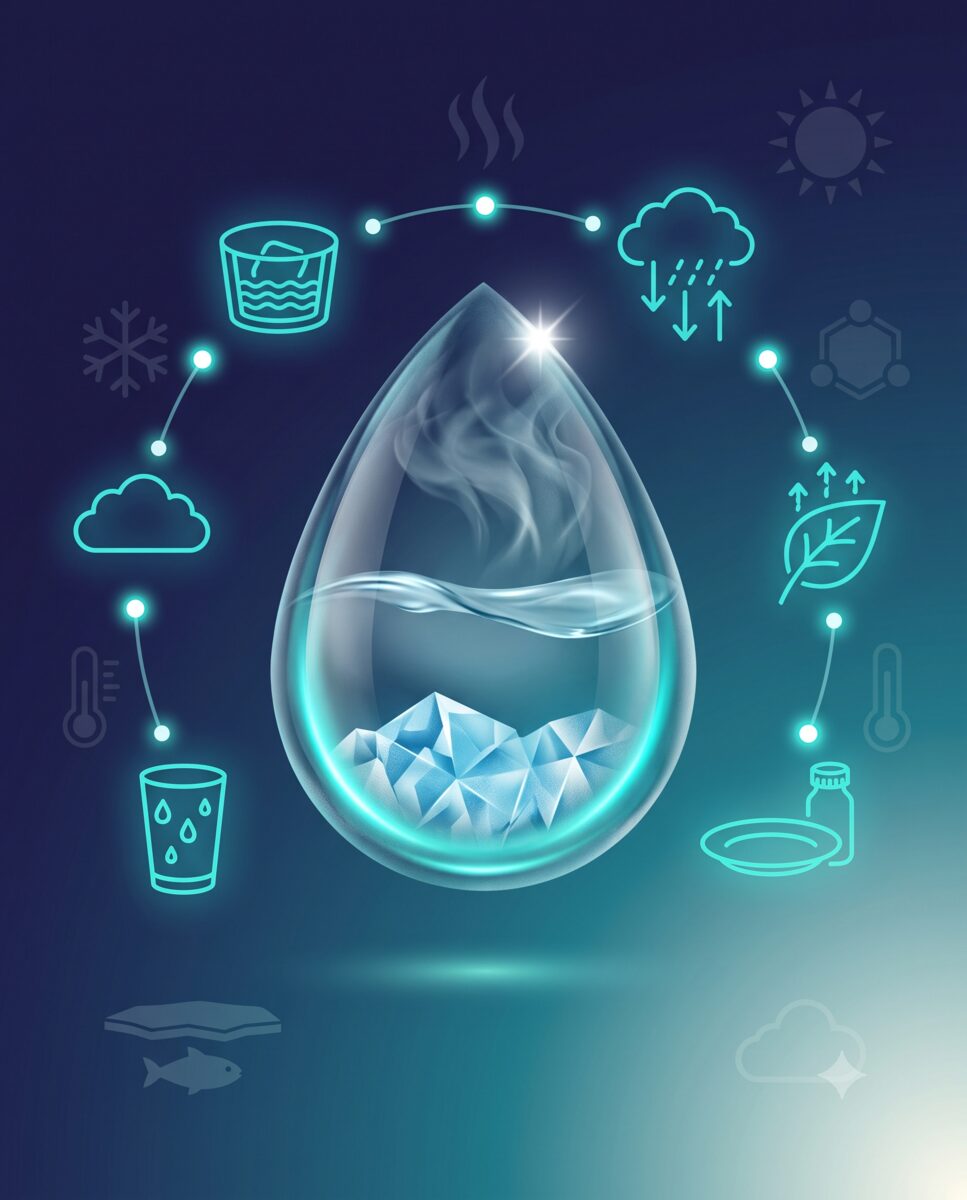
💧 The Three States of Water
- Water uniquely exists as solid (ice, snow, hail), liquid (drinking water, rivers), and gas (invisible water vapour)
- All three are the exact same chemical substance — H₂O — just with different molecular motion and spacing
- Solid ice has a fixed shape and volume and does not flow
- Liquid water has a fixed volume but takes the shape of its container and flows easily
- Gaseous water vapour has no fixed shape or volume — it spreads to fill any available space and is completely invisible
🔄 Interconversion of States
- Melting: solid ice changes to liquid water upon heating
- Freezing: liquid water changes to solid ice upon cooling
- Evaporation: liquid water changes into water vapour at the surface, at any temperature below boiling
- Condensation: water vapour cools and changes back into liquid water droplets
- These are reversible physical changes — no new chemical substance is ever formed
🌍 The Water Cycle
- Evaporation: the sun heats oceans, rivers and lakes, turning liquid water into invisible vapour
- Transpiration: plants release excess water vapour into the air through their leaves
- Condensation: rising vapour cools and forms visible clouds of tiny droplets or ice crystals
- Precipitation: clouds get heavy and water falls back as rain, hail, or snow
- Collection: precipitation collects in rivers, lakes, oceans and underground reservoirs, restarting the cycle
🔑 Key Terms
Evaporation
Spontaneous surface phenomenon where liquid turns to gas at any temperature below boiling point
Boiling
Rapid bulk phenomenon where liquid turns to vapour throughout, exactly at 100°C, with visible bubbles
Condensation
Water vapour cooling down and losing heat to change back into liquid droplets
Precipitation
Water falling from clouds back to Earth as rain, hail, or snow
Transpiration
The process by which plants release excess water vapour through their leaves
Collection
Precipitated water gathering in rivers, lakes, oceans and underground reservoirs
Quick Recall — Sprint Facts
Same Substance
Ice, water and vapour are all exactly H₂O in different forms
Invisible Gas
Water vapour is a true gas and is completely invisible
Any Temperature
Evaporation can happen below boiling point, even in the shade
Fixed Points
Boiling happens at 100°C; freezing happens at 0°C
Cooling Effect
Evaporation absorbs heat from surroundings, causing cooling
MythBuster
Clouds are NOT gas — they are visible liquid droplets or ice crystals
🏆 Olympiad & Challenger Edge
Anomalous Expansion
Water reaches its maximum density at exactly 4°C. Below this, it expands by roughly 9% as it freezes, forming an open crystalline structure — this is why ice is less dense than liquid water.
Why Ice Floats & Fish Survive
Because ice expands and floats, lakes freeze from the top down. The floating ice layer insulates the water below, letting fish and aquatic plants survive harsh winters.
Latent Heat of Vaporization
During a phase change, temperature stays constant because the heat supplied is used to break intermolecular forces, not raise temperature — this is why steam at 100°C burns worse than boiling water at 100°C.
Evaporation vs. Boiling
Evaporation is strictly a surface phenomenon happening at any temperature below boiling point. Boiling is a bulk phenomenon occurring throughout the entire liquid volume, only at exactly 100°C.
❌ "Gas turning to liquid" only
Incomplete. You must mention the loss of heat energy — condensation is water vapour cooling down to change into liquid droplets.
❌ Evaporation needs a stove
Wrong. Evaporation is a continuous surface phenomenon that happens spontaneously at any temperature below boiling, using ambient heat.
❌ Evaporation = Boiling
No. Evaporation is a quiet surface phenomenon at any temperature; boiling is a violent bulk phenomenon only at 100°C.
❌ Missing the Collection stage
The water cycle isn't complete at precipitation — water must collect in rivers, lakes, oceans and reservoirs before evaporating again.
🏺 The Zero-Electricity Cooler
The Pot-in-Pot (Zeer) cooler uses NCERT Activity 8.9's principle — wet sand between two clay pots. Evaporation from the porous clay pulls heat from the inner pot, keeping food cold with no electricity.
🏃 Sweating as Natural AC
When we get hot, we sweat. As the liquid sweat evaporates, it absorbs heat from our skin — evaporative cooling acting as the body's own air conditioner.
👕 Drying Laundry Smart
We spread wet laundry out flat on a clothesline instead of leaving it bunched up, because larger surface area speeds up evaporation.
💦 Dew and Foggy Mirrors
Dew drops form on grass on cold winter mornings, and bathroom mirrors fog up after a hot shower — both are condensation happening naturally, indoors and outdoors.
🚨 Clouds are NOT water vapour
Water vapour is invisible. Clouds are actually massive collections of tiny liquid water droplets or solid ice crystals condensed around dust particles.
🚨 Steam vs. water vapour
What you see rising above a boiling pot isn't invisible vapour — it's already condensed liquid droplets formed as hot vapour hits cooler air.
🚨 Evaporation location
Always specify that evaporation occurs exclusively at the surface of the liquid — examiners deduct marks if this is missed.
🚨 Glass "leaking" water
A cold glass doesn't leak. Warm air's invisible water vapour hits the cold surface, loses heat, and condenses into visible droplets.
Logic Chain — How Evaporation Cools You Down
Step 1
Heat energy applied to liquid connects to surface molecules gaining kinetic energy
Step 2
High-energy molecules breaking free connects to them escaping as gas through evaporation
Step 3
The escape of high-energy molecules connects to a drop in the remaining liquid's average kinetic energy
Step 4
Lower kinetic energy connects to the liquid absorbing heat from its surroundings, cooling the surface
🦉
Mentor Byte
"Water never truly disappears — it only changes address. A puddle vanishing in the sun hasn't left the planet; it has simply joined the sky, waiting to fall again as rain. Once a student sees the water cycle as one continuous journey rather than separate facts, the whole chapter clicks into place."
💛 Parent Tip
Next time you make tea or watch a kettle boil, ask your child to spot the difference between the quiet steam rising slowly off a cup of water and the vigorous bubbling of the boiling kettle. This side-by-side moment makes evaporation vs. boiling unforgettable.