Class 6 | English
Chapter 4 | The Unlikely Best Friends
Aligned with CBSE | NCERT | School & Olympiad Standards
Focus on What Matters Most
The67Sprint
📚 Text Context & Source
- Class 6 English Poorvi, Unit 2 (Friendship), Chapter 4
- Adapted from the ancient Buddhist Jataka Tales ("The Elephant and the Dog"), which carry over two thousand years of life values and wisdom
- Retold by Subba Rao (kathakids.com)
Jataka Tale 🐘
🐘 Gajaraj & Buntee
- Gajaraj — a royal elephant in the best booth of the royal stables; showered with luxuries by the king, yet lonely for lack of a playmate
- Buntee — a stray dog who strays into the stable tired and hungry; he becomes Gajaraj's loyal, inseparable friend
👨🌾 The Mahout & The Farmer
- Mahout — elephant trainer and caretaker; gives excellent physical care (food, daily baths) but not emotional companionship
- Farmer — Buntee's original owner; loves his dog, but shows deep empathy by freeing Buntee when he sees him pining for Gajaraj
🍚 Part I — Encounter & Bond
- Stray dog Buntee enters the stable; Gajaraj shares his food while munching
- Buntee wags his tail in gratitude, eats and sleeps; the mahout notices and lets the dog stay
- They bond at daily pond baths: Gajaraj splashes water while Buntee yelps (he hates showers)
- They go on rides with Buntee sitting on Gajaraj's back
💔 Part II — Separation
- A passing farmer recognises Buntee as his lost pet and leads him away with a rope around his neck
- Buntee yelps and Gajaraj winces in pain; both stop eating out of grief
- The mahout checks Gajaraj's tummy for indigestion and realises he is missing his friend
🤗 Part II — Reunion & Conclusion
- The farmer sees Buntee's untouched food, realises his heartbreak and unties the rope
- Buntee licks the farmer's hand in gratitude and sprints back; Gajaraj swings him joyfully with his trunk
- The mahout and farmer share a meal: two pairs of friends — Gajaraj & Buntee, and the Mahout & the Farmer
2 pairs of friends
⏳ Grammar 1 — Past Tenses
- Simple Past — strayed, pushed, yelped
- Past Continuous — was munching, was missing
- Past Perfect — had remained, had tied, had followed
🔗 Grammar 2 — Correlative Conjunctions
- neither…nor joins two negative facts or choices: "neither the farmer nor the mahout noticed that the two friends were in tears"
- either…or joins two positive alternatives where one applies
↔️ Grammar 3 — Prefixes & Opposites
- Negative prefixes un-, in-, dis-, mis-: happy → unhappy, indigestion, disappeared
- Antonyms in the text: sad ↔ filled with joy / delighted, awake ↔ asleep, relieved ↔ worried, missing ↔ found
🌱 Grammar 4 — Root Words & Suffixes
- A suffix added to a root word makes a new word
- friend + ly = friendly
- magic + al = magical
- courage + ous = courageous
Central Idea
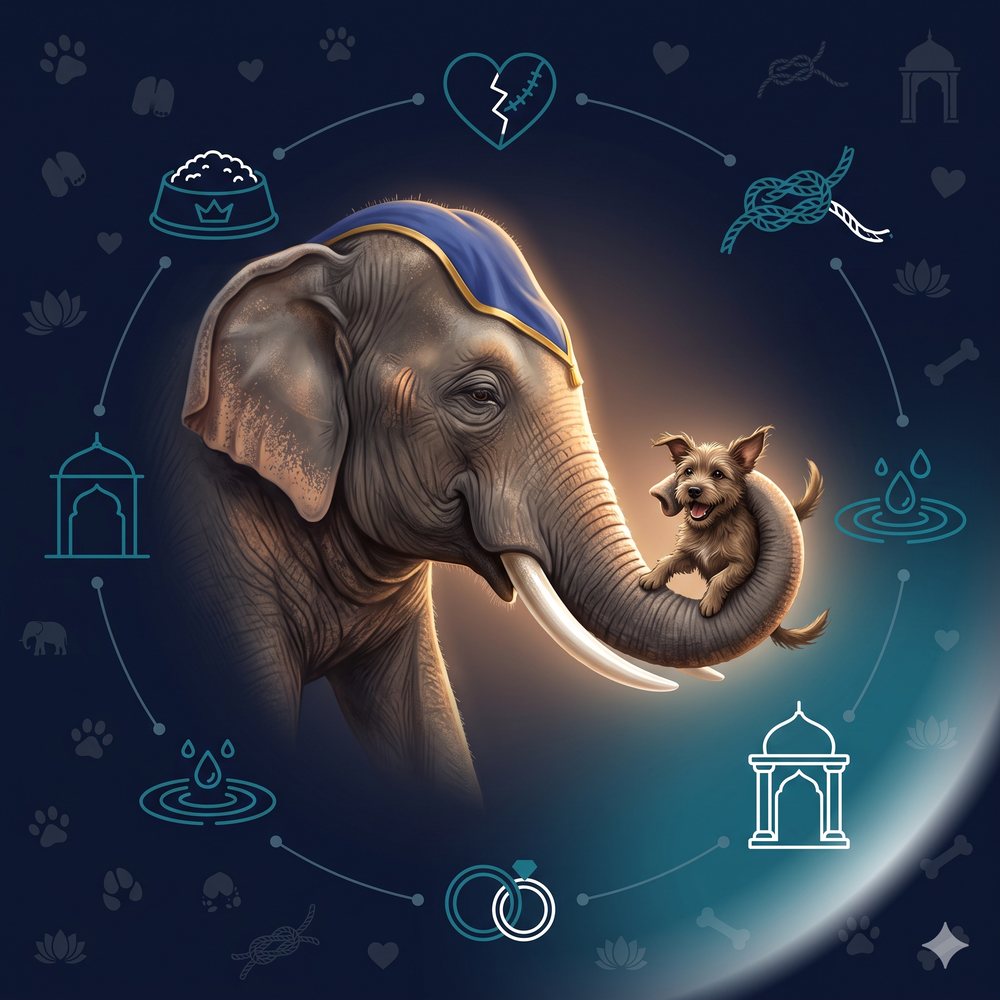
A caretaker meets needs; a friend meets the heart. True friendship crosses species and size, and caring means putting a friend's happiness first.
Quick Recall — Sprint Facts
Textbook & Unit
NCERT Class 6 Poorvi, Unit 2 (Friendship), Chapter 4
Source Origin
Buddhist Jataka Tales, "The Elephant and the Dog"; retold by Subba Rao
Origin & Age
Preserved orally and in text for over 2,000 years
Primary Setting
Best booth in the Royal Stables and the Elephant Pond
Key Characters
Gajaraj (elephant), Buntee (dog), the Mahout and the Farmer
Daily Bonding
Pond baths, splashing water and trunk rides on Gajaraj's back
Gestures of Gratitude
Buntee wagged his tail when first fed, and licked the farmer's hand before sprinting back
Food Strike
Both animals refused food for multiple consecutive meals after separation
Act of Freedom
The farmer untied the rope around Buntee's neck
Reunion
Gajaraj lifted Buntee with his trunk and gave him a joyous swing
Friends at the End
Gajaraj & Buntee, AND the Mahout & the Farmer
Real-Life Parallel
Tarra (elephant) and Bella (dog) at an Elephant Sanctuary in Tennessee, USA; Tarra stood outside a building for 3 weeks while injured Bella recovered
Companion Poem
"A Friend's Prayer" by Jill Wolf
Conjunction Pairs
neither…nor (negative); either…or (positive)
🔑 Key Terms
Booth
A rectangular space allotted for an animal inside a stable
Stables
Living spaces set aside for royal animals such as horses and elephants
Mahout
A person who takes care of, trains and handles elephants
Interacted with
Engaged or communicated with someone
Strayed
Wandered or came into a place by mistake
Munching
Chewing food steadily and audibly
Wagged
Moved a tail rapidly from side to side to show pleasure or gratitude
Convey
To communicate or express a feeling or message
Crumbs
Small broken pieces of food
Accompanied
Went along with someone as a companion
Plunging
Jumping or diving directly into water
Trunk
The long, flexible nose of an elephant, used for eating, spraying water and grasping
Yelped
Uttered a short, sharp cry of pain, surprise or distress
Splashed
Threw water wildly onto a surface or companion
Delighted
Very happy, pleased or overjoyed
Hugged
Held someone tightly in one's arms to show affection
Disappeared
Vanished from sight; ceased to be visible
Realise
To become fully aware of or understand a fact or situation
Winced
Shrunk back slightly or grimaced because of distress or pain
Chores
Routine daily household or farm duties
Slight
A minor, small or insignificant degree
Indigestion
Stomach discomfort causing difficulty in digesting food
Tummy
Informal, child-friendly word for stomach
Sprang
Jumped or bounded up suddenly and rapidly
Joyous
Full of immense happiness and joy
Relieved
Happy and reassured because a worry has ended
Satisfaction
Quiet contentment when a need is fulfilled
Swing
To move smoothly back and forth while suspended
🏆 Olympiad & Challenger Edge
Physical Care vs Emotional Well-being
Royal booth and regular meals satisfy survival needs, but the higher needs of belonging and affection stay unfulfilled without companionship. That is why Gajaraj was lonely.
Non-Verbal Cues — Joy & Gratitude
The author shows animal emotion through body cues, not dialogue: tail wagging, hand licking and trunk swinging.
Non-Verbal Cues — Grief & Distress
Yelping, wincing, tears and a total refusal of food show grief. Emotional distress can suppress the body's appetite even when no illness is found.
Comparative Literary Synthesis
Compare Gajaraj and Buntee with the Jataka legacy and the Tarra and Bella report. Both show that companionship goes beyond species, size and physical barriers.
❌ Mahout = Gajaraj's Friend?
Wrong. The mahout was a caretaker who met practical needs (food, grooming, safety). A friend gives emotional closeness, play and companionship.
❌ The Farmer Was Cruel?
Wrong. He was happy to regain his lost pet, and when he saw Buntee's grief he selflessly removed the rope.
✍️ Tense Sequence
Simple Past for a completed action ("The farmer untied the dog"), Past Continuous for the background ("while Gajaraj was munching"), Past Perfect for an earlier action ("Buntee had not touched his food").
✍️ Neither…Nor / Either…Or
Neither…nor joins two negatives (both are false). Either…or joins two positives (one applies). Never mix them: not neither…or or either…nor.
✍️ Name Both Pairs
"Who were friends at the end?" needs both: Gajaraj and Buntee, AND the Mahout and the Farmer.
✍️ Stay in One Tense
Don't switch tenses in answers. Write "The farmer saw Buntee and tied a rope", not "sees Buntee and tied".
❌ Gajaraj Was Ill?
Wrong. The mahout checked Gajaraj's tummy and found only slight indigestion at most. Gajaraj stopped eating because he was missing Buntee.
✍️ Prefixes & Suffixes
Prefixes un-, in-, dis-, mis- give opposites (unhappy, indigestion, disappeared). Suffixes build words: friend + ly = friendly, magic + al = magical, courage + ous = courageous.
✍️ Caretaker vs Friend
Show character motivation, not just plot: use cause-and-effect to explain why Gajaraj stopped eating.
🐾 Cross-Species Empathy
Animal behaviour studies show that social animals like elephants and dogs need emotional bonds to thrive.
🏞️ Real Sanctuary Evidence
Tarra the elephant and Bella the dog at the US Elephant Sanctuary show that bonds across species are real and documented.
🧸 Socio-Emotional Health
Good food, a big home and gadgets cannot replace friendship and play.
🤝 True Friendship Values
As in "A Friend's Prayer", a true friend accepts you as you are, shares hopes and stands by you in trouble.
🐶 Pet Separation
Pets can feel separation anxiety, so they need companionship as well as shelter.
🐘 Human–Wildlife Coexistence
Empathy for animals applies to conservation too, for example wildlife corridors for elephants.
💛 Selfless Decisions
Like the farmer, put a friend's or pet's real happiness ahead of your own ownership.
🔠 Exact Spellings
Spell these exactly: mahout, indigestion, delighted, strayed, satisfaction, correlative.
🧩 Analogy 1
In "mahout : kind :: Gajaraj : ______" the answer is sad or lonely.
🧩 Analogy 2
In "Gajaraj : Buntee :: ______ : farmer" the answer is mahout.
📝 Incomplete Conclusion
Naming only Gajaraj and Buntee loses marks. State both pairs of friends.
🔤 Singular Verb Agreement
With singular subjects, neither…nor and either…or take a singular verb: "Neither Gajaraj nor Buntee was eating".
🔠 Suffix Spellings
Write courageous (courage + ous) and magical (magic + al). Not "magiction" or "delightness".
🐘 Tarra's Three Weeks
Exact fact: Tarra stood outside a building for 3 weeks while Bella, the injured dog, recovered.
🔡 Word Look-Alikes
Keep similar words apart: yelped (a sharp cry) vs winced (shrank back), and strayed (wandered) vs stayed.
Logic Chain — How Kindness Builds Two Friendships
Step 1 — Kindness
Gajaraj shares his food with the hungry stray Buntee, which leads Buntee to wag his tail and settle in
Step 2 — Bond
Daily pond baths, splashing and trunk rides lead to an inseparable friendship that ends Gajaraj's loneliness
Step 3 — Separation
The farmer leads Buntee away on a rope, which leads both animals into grief and a refusal to eat
Step 4 — Empathy
The mahout and the farmer notice the grief, which leads the farmer to untie Buntee, reuniting the friends and forming a second pair of friends
🦉
Mentor Byte
"When tackling literature questions in Class 6 Poorvi, examiners look for textual exactness and thematic depth. Don't just summarise the plot — explain character motivations, using cause and effect. Master the difference between a 'caretaker' and a 'friend', give complete lists in multi-character questions (both pairs of friends!), and use past tenses and correlative conjunctions (neither…nor / either…or) with zero errors. Grammar topics are tested through the story's context, so study them together."
For Parents
Ask your child why Gajaraj stopped eating even though the mahout found nothing wrong with his tummy. Then ask them to describe the difference between a caretaker and a friend in their own words, which tests whether the main idea has sunk in.