Class 6 | SST
Chapter 8 | Unity in Diversity, or 'Many in the One'
Aligned with CBSE | NCERT | School & Olympiad Standards
Focus on What Matters Most
The67Sprint
🇮🇳 Unity in Diversity
- India is one nation where many different languages, religions, cultures and traditions live together in harmony — this is the "Many in the One."
- Unity does not mean uniformity: a cricket team wins together while every player brings a different skill — differences enrich the team, they don't divide it.
🎵 The National Anthem — Unity Sung Aloud
- Jana Gana Mana names India's diverse regions one by one — Punjab, Sindh, Gujarat, Maratha, Dravida, Utkala, Banga — inside a single song sung by the whole nation.
- It is the most literal picture of the "Many in the One": distinct regions named individually, united in one anthem.
🍛 Food for All
- Thousands of regional dishes rest on the same staple grains — cereals (rice, wheat, barley) and millets (bajra, jowar, ragi) — plus pulses (dals) everywhere.
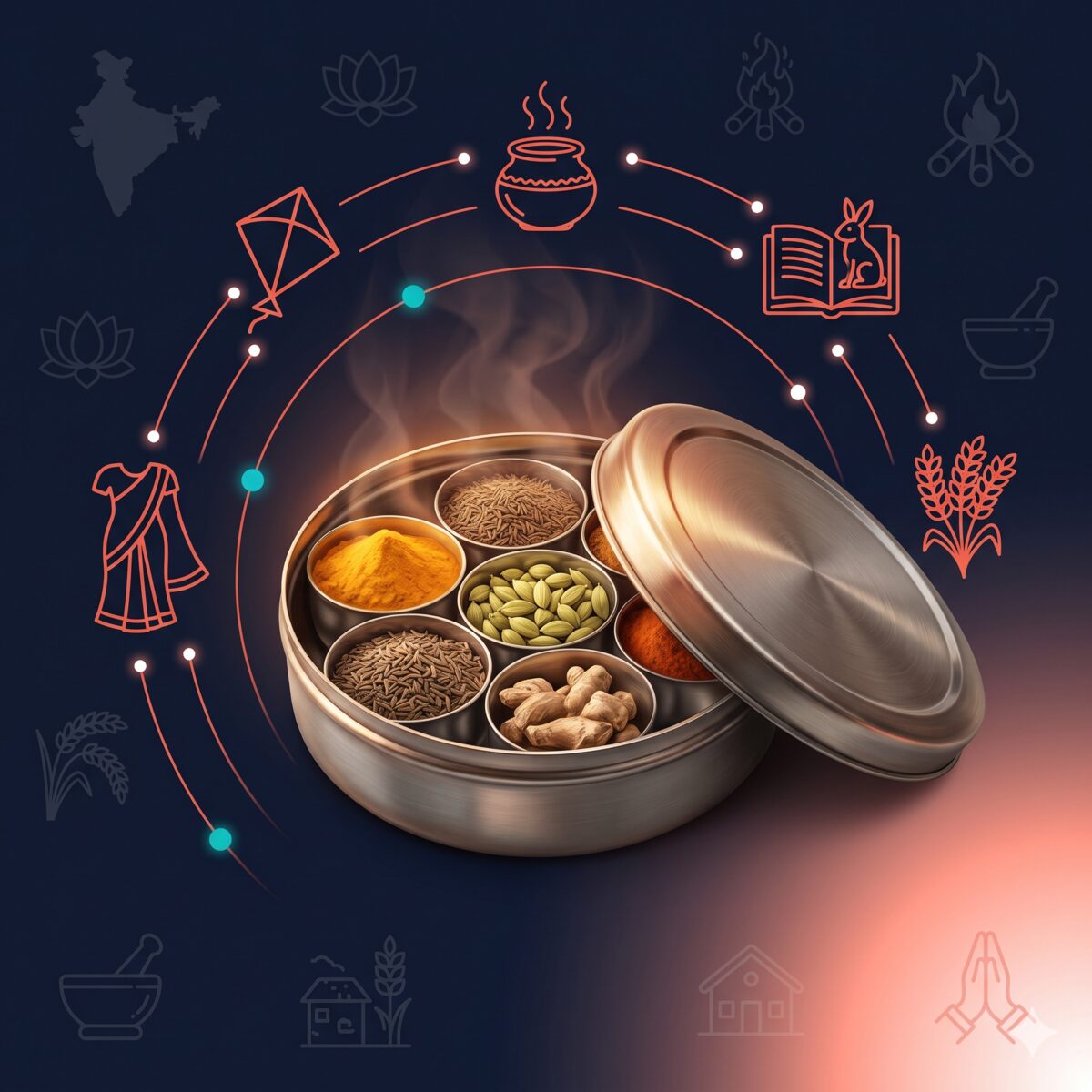
- The same spices — turmeric, cumin, cardamom, ginger — travel from an Assam kitchen to a Gujarat kitchen, even when the dish itself is completely different.
🥻 Textiles — The Sari & Dhoti
- The sari is an unstitched cloth worn nationwide, but draped differently by region: Nauvari style in Maharashtra, Atpoure style in West Bengal.
- Fabrics also vary by region — Banarasi, Kanjivaram, Paithani — while the dhoti (Veshti in Tamil Nadu) plays the same unifying role for men.
📖 Epics & Folklore
- The Panchatantra — animal fables like "The Tortoise and the Geese" (patience) and "The Lion and the Hare" (wit over strength) — has ~200 adaptations in 50+ languages.
- The Ramayana and Mahabharata carry shared values of dharma into tribal folklore too — the Bhils, Gonds and Mundas each have their own local versions mapping epic heroes onto their own forests and hills.
Quick Recall — Sprint Facts
1.4 Billion
India's population — roughly 18% of the world's people
4,635 · 325 · 25
Communities, languages and scripts documented by the 'People of India' project
14 January
Harvest festival day — Pongal, Lohri, Uttarayan, Magh Bihu all fall here
2,200 Years
Age of the Panchatantra — still adapted worldwide today
Prejudice
A negative judgement — the thought
Discrimination
Unfair treatment based on that judgement — the action
The67Sprint
🔑 Key Terms
Unity in Diversity
Different cultures and traditions coexisting within one shared national identity
Staple Grains & Spices
Everyday crops (rice, wheat, millets) and shared spices (turmeric, cumin) that form the base of diverse regional diets
Unstitched Garments
Clothing like the sari and dhoti — one form, many regional draping styles
Epic & Folklore
Narrative poems (Ramayana, Mahabharata) and fables (Panchatantra) weaving a shared moral framework across India's regions
Prejudice
A preconceived negative opinion about a person or group, without good reason
Stereotype
A rigid, simplified image of a group that ignores individual differences
The67Sprint
The67Sprint
🏆 Olympiad & Challenger Edge
The Thali, Not the Melting Pot
In a melting pot everything blends into one uniform soup. In a Thali, the dal, sabzi and rice sit on one plate but keep their own distinct flavours — the sharper metaphor for Unity in Diversity.
The Chintz Ban
17th-century Indian printed cotton called Chintz was so popular in Europe that England and France banned its import to protect their own struggling textile industries.
Symphony, Garden, Choir
Advanced analogies for pluralism: an orchestral symphony (distinct instruments, one composition), a flower garden (diverse flora, one landscape), a vocal choir (distinct ranges, one harmony).
Mapping Epics onto Geography
Anthropologist K.S. Singh observed that local folklore places the Pandavas in nearly every corner of the country — communities mapped national epics onto their own physical landscape.
Unity ≠ Uniformity
The single most common error. Unity in Diversity means celebrating unique differences under one national bond — not forcing everyone to be the same.
Prejudice vs. Discrimination
Prejudice is the internal thought or judgement. Discrimination is the outward, unfair action based on that thought. Keep them separate in your answer.
Exact Festival–State Match
Pongal → Tamil Nadu. Lohri → Punjab. Magh Bihu → Assam. Uttarayan → Gujarat. Mixing these up is a frequent mark-loser.
Name the Draping Styles
Writing "clothes differ by region" is too vague. Always name the actual example: Nauvari (Maharashtra) vs. Atpoure (Bengal).
The Tiffin Box Test
One friend brings a paratha, another idli — different dishes, same base of wheat or rice underneath.
The Masala Dabba
Open a spice box in Gujarat or Assam — turmeric, cumin and ginger sit in both, no matter how different the final dish tastes.
The Sari's Second Life
An unstitched sari doubles in rural homes as a baby's swing, a sunshade, or a bag for carrying grain.
Singing the Anthem Together
Every school morning, students across every state sing the same anthem naming all of India's regions — unity in a single shared moment.
Vague Answers Lose Marks
"People wear clothes differently" earns little credit. Long answers need a named textbook example every time.
Incomplete Stereotype Definition
A stereotype isn't just "a thought about a group" — it must reduce complex people to one rigid, oversimplified image.
Formatting Penalty
One giant paragraph loses marks. Use a short intro, clear sub-points with headings, and a brief conclusion.
Epics Aren't "Sanskrit-Only"
Don't assume classical epics belong only to scholars — tribal communities like the Bhils and Gonds have their own rich oral versions.
Logic Chain — How Regional Food Stays One Cuisine
Step 1
Diverse climates and geography connect to different regional crops — rice in the east and south, wheat in the north.
Step 2
These distinct staple crops connect to thousands of different regional dishes, each cooked its own way.
Step 3
Trade and shared cultural habits connect every region to the same core spices — turmeric, cumin, ginger.
Step 4
The shared spice base leads to one underlying culinary identity — different dishes, unified by the same flavour foundation.
🦉
Mentor Byte
"Don't treat this chapter as a list of separate facts. Be a cultural detective — ask what invisible thread links Lohri and Pongal. A farmer in Punjab and a farmer in Tamil Nadu look up at the same sun, in the same week of January, celebrating the same harvest under different names. Once you see the One hiding inside the Many, you've understood India, not just memorised it."
💛 Parent Tip
Open your own spice box together and ask your child to name a dish from a different state that uses the same turmeric and cumin — a small kitchen moment that makes "Unity in Diversity" concrete rather than abstract.