Class 7 | SST
Chapter 4 (Pt II) | Turning Tides: 11th and 12th Centuries
Aligned with CBSE | NCERT | School & Olympiad Standards
Focus on What Matters Most
The67Sprint
⚔️ A Period of Major Transition
- The 11th–12th centuries were a major turning point: old political systems weakened while regional art and culture thrived
- Turkic powers (Ghaznavids, Ghurids) from Central Asia entered North India through the Khyber Pass
- The Hindu Shahi dynasty (rulers Jayapala, Anandapala) controlled the Khyber Pass and were the first defensive barrier against invasion
🏇 Ghazni vs. Ghuri
- Mahmud of Ghazni: 17 campaigns (1000–1026 CE) to plunder wealth (e.g. Somnath temple), then returned to Afghanistan
- Muhammad Ghuri: aimed for permanent territorial expansion and political control
- Second Battle of Tarain (1192 CE) — Ghuri's victory laid the foundation of the Delhi Sultanate
- Qutb-ud-din Aibak was the commander left behind by Ghuri to consolidate and govern the conquered territory
🏛️ Regional Powers & Learning Loss
- Cholas (South), Hoysalas (Karnataka), Kakatiyas (Deccan), Eastern Gangas (Odisha), Paramaras (Central), Senas (Bengal), Chahamanas (North/Central) ruled thriving regions
- Chandelas of Central India mounted stubborn resistance against Mahmud's forces
- Bakhtiyar Khilji destroyed Buddhist mahaviharas (Nalanda, Vikramashila), causing massive loss of manuscripts and a setback to institutional learning
🕌 Cultural & Scientific Golden Age
- Despite political disruption in the North, art and science flourished elsewhere in this period
- Bhaskaracharya (b. 1114 CE) wrote brilliant mathematical texts including the Lilavati
- Magnificent temples were built, including the Konark Sun Temple, Brihadeshvara Temple, and the star-shaped temples at Belur
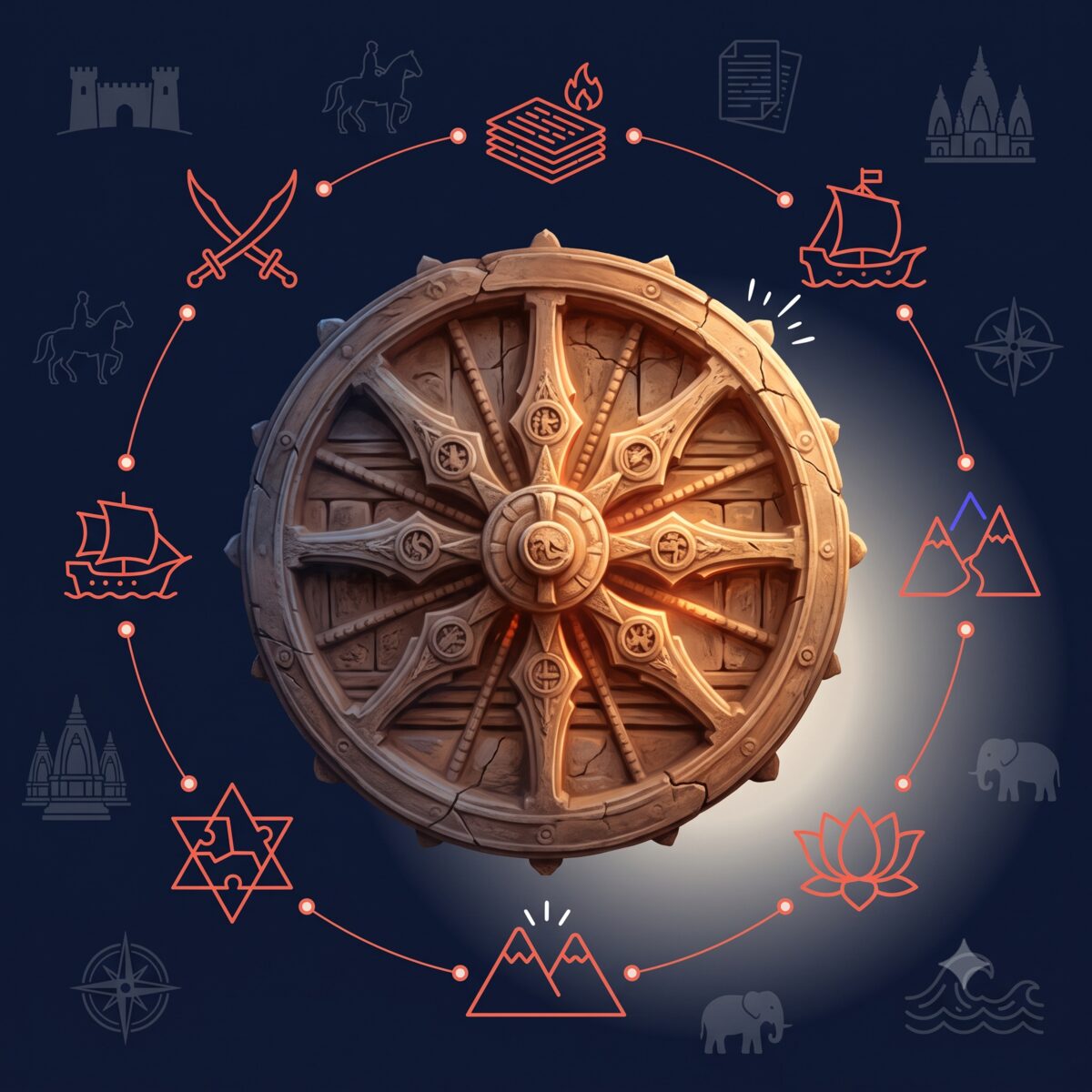
Quick Recall — Sprint Facts
1000–1026 CE
Mahmud of Ghazni's 17 military campaigns into India
1191 CE
First Battle of Tarain — Prithviraj Chauhan defeats Muhammad Ghuri
1192 CE
Second Battle of Tarain — Muhammad Ghuri defeats Prithviraj Chauhan
1114 CE
Birth of Bhaskaracharya, India's great mathematician
1025 CE
Rajendra Chola I's naval expedition to Srivijaya (Southeast Asia)
3,000–4,000 km
Distance travelled by the Chola naval fleet across the Bay of Bengal
🔑 Key Terms
Sultan
Arabic word for 'authority' or 'power' — a title for sovereign rulers wielding supreme political and military power
Mahavihara
A great Buddhist monastic university, such as Nalanda or Vikramashila, housing international students and vast libraries
Ghaznavids & Ghurids
Turkic dynasties from present-day Afghanistan (Central Asia) that invaded the Indian subcontinent in this period
Anubhava Mandapa
A "pavilion of experience" founded by Basavanna, where people of all backgrounds gathered to discuss ethics and religion
Mounted Archers & Cavalry
Rapid military tactics using skilled horseback archers that overwhelmed traditional Indian defences
Hindu Shahi
The dynasty (rulers Jayapala, Anandapala) that controlled the Khyber Pass and first resisted the Ghaznavid invasions
🏆 Olympiad & Challenger Edge
Al-Biruni's Objectivity
Though he travelled with Mahmud of Ghazni's army, the Persian scholar Al-Biruni praised the defeated Hindu Shahi rulers as noble and just — separating intellectual honesty from political rivalry.
Chola Naval Logistics
Rajendra Chola I's fleet crossed 3,000–4,000 km to dismantle Shrivijayan monopolies and secure maritime trade routes to China — a feat of monsoon navigation and supply-chain engineering.
The Scholar-King Bhoja
Paramara ruler King Bhoja wrote texts on architecture, governance, and medicine, and engineered the massive Bhojtal lake system — a rare warrior-intellectual.
Lilavati's Gamified Maths
Bhaskaracharya's Lilavati taught algebra and arithmetic through riddles about bees, elephants, and monkeys — a 12th-century precursor to today's maths gaming apps.
Exam Ready
❌ Reversing the Battles of Tarain
1191 CE = Prithviraj Chauhan wins. 1192 CE = Muhammad Ghuri wins. Swapping these costs heavy marks.
❌ Incomplete Dynasty Mapping
Never just list dynasty names — always connect each to its region: Senas in Bengal, Hoysalas in Karnataka, Eastern Gangas in Odisha.
❌ Confusing Invader Motives
Ghaznavids (11th c.) = wealth extraction. Ghurids (12th c.) = permanent territorial rule. Don't treat all Turkic invaders as the same.
❌ Wrong Geographic Origin
The Ghaznavids and Ghurids were Turkic dynasties from present-day Afghanistan (Central Asia) — not the Middle East or Arabia.
Real World
🎮 Gamified Learning Apps
Bhaskaracharya's Lilavati taught maths through riddles and poetry about animals — exactly how modern educational gaming apps teach kids today.
🏆 Sports Team Resilience
Like a team that loses star players but still wins through teamwork, Indian culture showed resilience — local traders and artisans kept thriving even as capitals fell.
🚢 Global Supply Chains
The Chola naval expedition protecting trade routes to China is a medieval version of today's cargo ships safeguarding international supply chains.
📰 Unbiased Journalism
Al-Biruni praising the rival Hindu Shahi rulers is like a sports reporter who travels with one team but still honestly praises a rival's skill.
Watch Out!
🚨 "Dark Age" Assumption
Don't call the whole era a "Dark Age" — the North faced disruption, but the South, East, and Central regions saw a Golden Age of temples, trade, and science.
🚨 Nalanda Mistaken for a Fort
Historian Minhaj al-Siraj described Bakhtiyar Khilji's forces capturing shaven-headed "Brahmans" in a fortress — these were actually Buddhist monks at a mahavihara.
🚨 Missing Qutb-ud-din Aibak
Ghuri didn't rule India himself — he left commander Qutb-ud-din Aibak behind to consolidate the conquest and found the Delhi Sultanate.
🚨 Ignoring the Chandelas
The Chandelas of Central India are often left out — they mounted stubborn resistance against Mahmud of Ghazni's forces.
Logic Chain — How the Delhi Sultanate Began
Step 1
Old regional polities weaken, and powerful new regional kingdoms (Cholas, Chahamanas) rise, connecting to a fragmented North Indian political landscape
Step 2
Ghaznavid raids through the Khyber Pass plunder wealth from temple cities, which leads to weakened northern defences over repeated campaigns
Step 3
Muhammad Ghuri shifts strategy from plunder to territorial conquest, which leads to the decisive Second Battle of Tarain in 1192 CE
Step 4
Ghuri's victory allows commander Qutb-ud-din Aibak to stay and consolidate rule, which establishes the foundation of the Delhi Sultanate
🦉
Mentor Byte
"History rarely splits neatly into 'good times' and 'bad times.' Draw a line down your notebook: on the left, list Disruptions — the fall of Nalanda, the Battles of Tarain. On the right, list Creations — the Konark Sun Temple, Bhaskaracharya's mathematics. Mastering 'Change and Continuity' means holding both columns in your head at once."
💛 Parent Tip
Ask your child to name one thing that was "lost" in this chapter and one thing that was "built" at the same time. This simple pairing exercise cements the Dual Legacy idea far better than memorising dates alone.